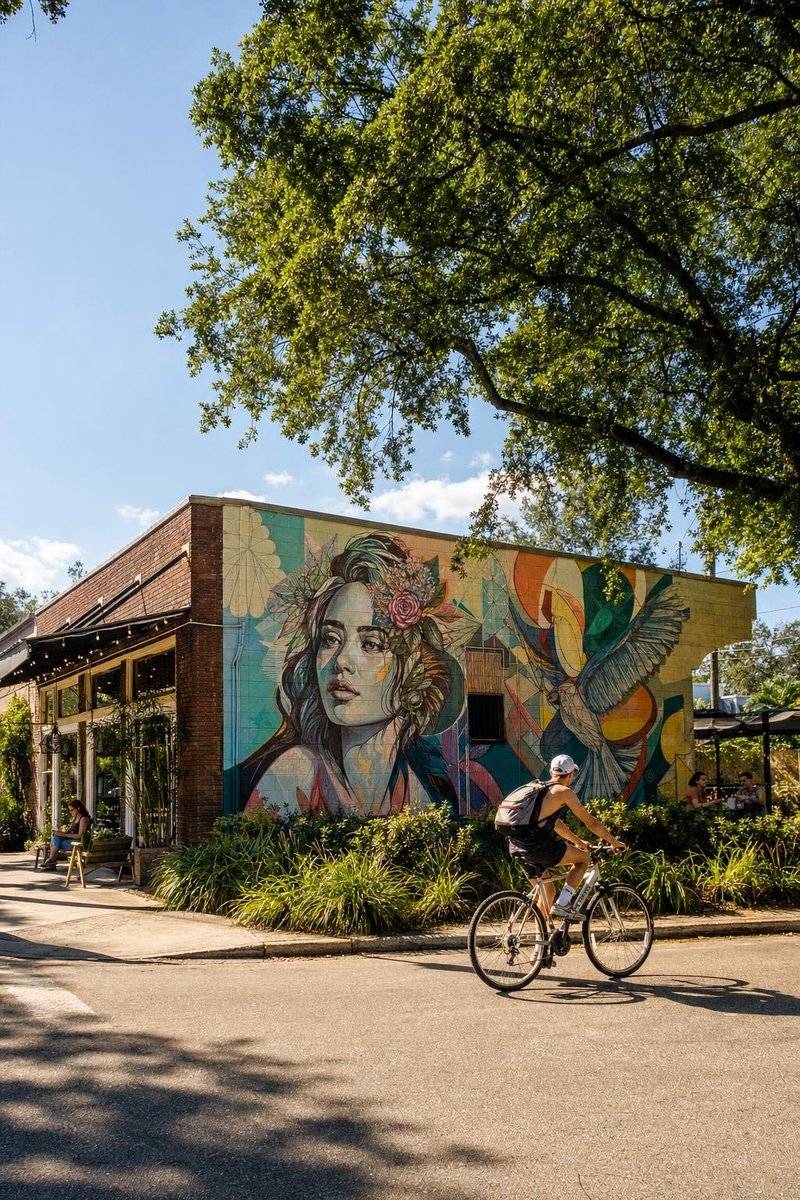
Blocks of warehouses in Miami's Wynwood district, once a tired industrial strip, had by 2013 become one of the most photographed places in Florida, covered wall to wall in large-scale street art. A Tampa resident who visited came home with a question: why not Seminole Heights?
The idea, posted in the autumn of 2013, collected 157 likes and ranked second among civic ideas for Tampa at the time.
The neighborhood
Seminole Heights sits a few miles north of downtown Tampa. It is really a cluster of neighborhoods (Old Seminole Heights, South Seminole Heights and Southeast Seminole Heights), built up mostly in the early twentieth century with Craftsman bungalows on brick streets. The main commercial corridors, Florida Avenue and Nebraska Avenue among them, carry long runs of one-story shops, garages and small industrial buildings.
In 2013 a lot of those buildings were half empty. Restaurants and bars had started moving in, and the area had a growing arts scene, with galleries such as Tempus Projects and small music venues drawing visitors from across the city. Between them stood plenty of blank brick and stucco.
What the idea proposed
The author described a local arts collective that wanted to take on the project in four plain steps. Find owners of buildings with large street-facing walls who would agree to a mural. Ask the City of Tampa for the necessary permits, and possibly a small grant. Recruit artists willing to work at scale. Then ask neighbors to back the effort with their voices, their skills and, where they could, their money.
One detail stood out. The artists would be paid. The proposal was not about volunteers spraying walls on a weekend, but about commissioning working painters, as Wynwood had done through its curated mural program run by the organizers of the Primary Flight project.
The reasons given were partly cultural and partly economic. The author argued that the corridors were lined with sad, barren buildings where businesses were trying to survive, and that a concentration of good murals could make Seminole Heights a destination. More foot traffic, the reasoning went, would help the restaurants and shops already there.
The idea was framed as a petition. It set no budget and asked for support rather than pledges, a common first step before approaching a city or a funder, as the guide on how to propose a project to your city explains.
What made the plan realistic
Murals on private walls are, in most cities, a negotiation between three parties. The property owner has to agree. The city has to be satisfied that the work complies with its sign and public art rules. Someone has to pay for paint, lifts and the artist's time. The idea named all three, which is more than many such proposals do.
Tampa also had the institutional pieces in place. The city runs an Art Programs Division that manages public art and puts out calls to artists, and Hillsborough County has its own public art program. Funding for murals on private property usually has to come from owners, businesses, sponsors or small grants, which is why the author pictured residents chipping in. The guide to community fundraising ideas covers the usual mix.
Murals that followed
Whether the arts collective named in the idea carried out its plan could not be confirmed. What is clear is that Seminole Heights did gain a lot of public art in the years that followed, through several routes.
A group calling itself the Seminole Heights Urban Art Partners organized a campaign to put murals on local businesses. The South Seminole Heights Neighborhood Association, working with the City of Tampa, commissioned nine artists to paint stormwater inlets, creating a walkable string of thirteen painted inlets that the association named the Art Trail. In 2017 a large painted mandala on a South Seminole Heights street became the city's first street mural. A newer mural titled "If I Could Fly" covers the Wayne C. Papy Athletic Center on North Florida Avenue.
Not all of it lasted. The South Seminole Heights mandala was later removed by state transportation crews under a state order targeting artwork painted on roads, a reminder that street art often depends on rules set well above the neighborhood level.
The Wynwood comparison never fully applied. Seminole Heights has no single warehouse district to cover, and its murals are scattered along corridors and side streets rather than packed into a few blocks. They are easier to find on foot or by bike than from a car on Florida Avenue.