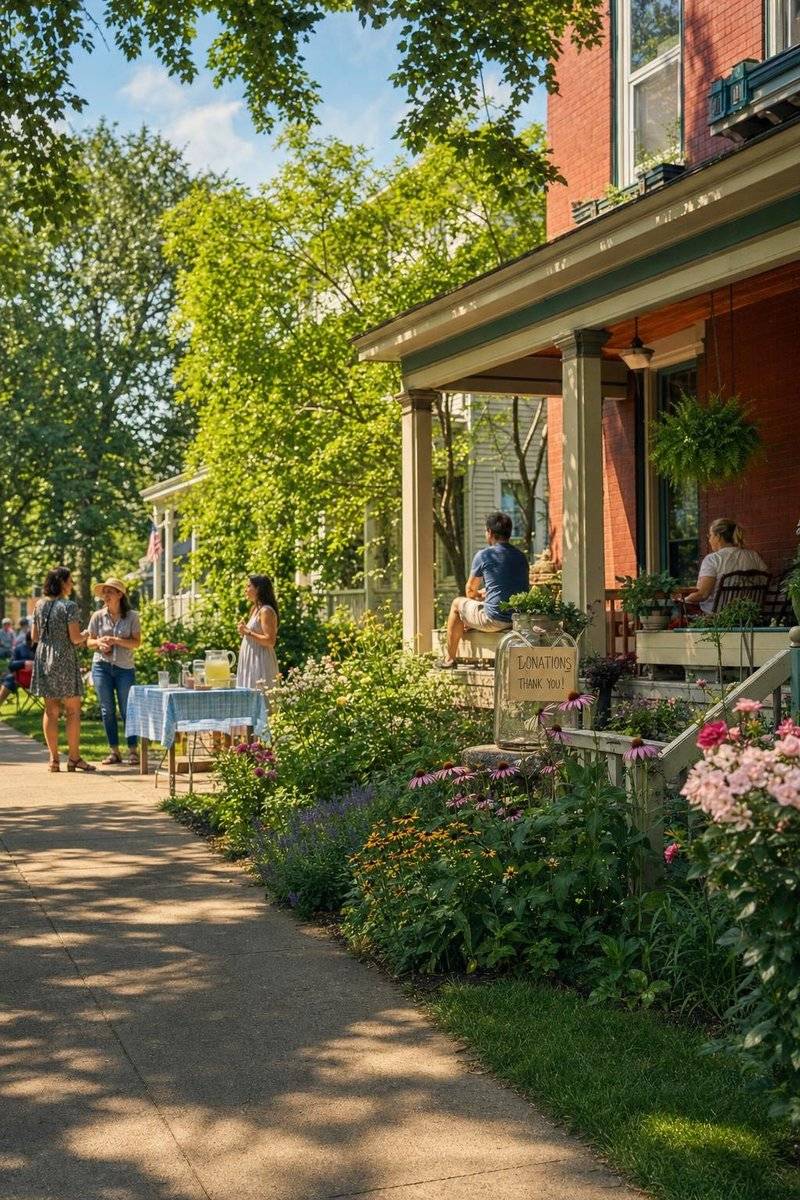
In Jackson, Michigan, a neighborhood watch group around Queen's Church wanted more watch signs for a few blocks between Brown Street and West Avenue. The sum was tiny, a few hundred dollars. What made the campaign work was a promise from the city's vice mayor, Derek Dobies, to match every donation. Nine backers covered the goal. Of all the community fundraising ideas that have paid for public things, the match is the most reliable, and it scales from street signs to statues.
Below are the formats that have worked for real public projects, with the reasons they worked. None of them requires a professional fundraiser.
011. The matched gift
A match gives donors a deadline and a multiplier. Someone with money to give (a business, a family trust, a local official, the city itself) pledges to double each gift up to a set amount.
In Pagosa Springs, Colorado, the Friends of Reservoir Hill wanted an observation deck on top of the downtown nature park, with views of the San Juan Mountains and panels about local history and ecology. A local family trust agreed to match every dollar raised. Forty-four backers funded the Reservoir Hill observation deck in full.
The match can also be the other way around. A large grant that requires local money turns small gifts into the key that releases it. Chicopee, Massachusetts raised $5,400 from residents that released a $20,000 playground grant and $5,000 in city money.
022. Price the thing, not the project
People give more easily to a tree than to an "urban forestry initiative." Break the project into units and price each one.
A neighborhood group in Alexandria, Virginia priced each park tree at $380 and explained the math: sapling, watering bag, staking, two years of watering. At Sheldon High School in Eugene, Oregon, a student-led Green Club priced the replacement of 1960s "wheel-bender" bike racks that let thieves steal everything but the front wheel. Its first phase, $1,080, was funded by 23 backers. The Sheldon High School bike parking campaign then returned for a second phase.
Unit pricing also works for benches, pavers, raised garden beds and playground pieces.
033. Shared public money plus private money
Some of the largest community campaigns start with public money already committed. In Naperville, Illinois, the public art group Century Walk wanted to install "The Spirit of the American Navy," a sculpture by E.M. Viquesney, as the sailor counterpart to the restored Doughboy statue it had placed at Burlington Square Park. The City of Naperville and Century Walk each put up $25,000. Residents and veterans' groups were asked for the rest, enough for a granite pedestal, sidewalks, lighting, benches and a small plaza. The Spirit of the American Navy campaign reached its $77,000 goal with 54 backers.
Donors are more confident when they can see the city has already paid in.
044. Events that do two jobs
A good event raises money and recruits volunteers at once.
In Tallahassee, a team working on a downtown "sense of place" initiative with the Tallahassee Downtown Improvement Authority wanted porch swings in the Capital Hill district, inspired by the popular swings at Lake Ella. After its first two Capital City Date Nights, the team reported funding for about ten more swings. In Tampa, residents pushing for a dog park in Seminole Heights proposed old-fashioned front-porch fundraisers alongside business sponsorships.
Plant sales, pancake breakfasts, fun runs and movie nights all fit this pattern. The money is usually modest. The mailing list is the real prize.
055. Sponsorships and naming
Local businesses like visible, permanent credit. Offer a named bench, a sponsored garden bed, a logo on a playground sign or a plaque on a tree. Set prices before you approach anyone, and check with the city about what signage is allowed on public land. Many parks departments have a written gifts and donations policy.
Memorial gifts belong here too. Middletown, Ohio's Public Works Department offered a Memorial Tree Program, a tree and plaque in a city park, which brings in steady money without a campaign.
066. Keep a tradition alive
Residents will pay to keep something they already love. The Noblesville Fireworks Festival in Indiana, a free Independence Day event with a downtown parade, games and a fireworks show at Noblesville High School, asked residents to help keep it free. The Noblesville fireworks festival raised more than $26,000 of its $33,800 goal. Even a partial result like that tells the city how much the event matters.
077. Phase it
Big goals intimidate donors. Split the project into phases, each of which buys something visible. Chickasha, Oklahoma separated its Centennial Park playground equipment from a later phase for a shelter and parking. Sheldon High replaced half its racks first, then asked for the rest. A completed first phase is also the best possible pitch for the second.
088. Online civic crowdfunding
Since the early 2010s, residents and cities have used online campaigns to co-fund public projects, often on an all-or-nothing basis where pledges are collected only if the goal is reached. That rule reassures donors and forces a realistic goal. Our guide to civic crowdfunding explains how the model works and where it has struggled.
For grant money to combine with these ideas, see community grants and tree planting grants.
One practical warning about all of these: before you collect any money, agree with the city on where it goes. Donations to a municipality for a public purpose are generally tax deductible, but only if they actually reach the municipality or a qualified charity.
FAQ
What are good fundraising ideas for a community project?
Matched gifts, unit pricing (per tree, per bench, per bed), business sponsorships with naming, events that also recruit volunteers, memorial gifts and phased goals have all paid for real public projects. The best choice depends on the size of the gap. A few hundred dollars suits a single event; tens of thousands usually needs a match, a sponsor and a public campaign together.
How do I find a matching donor?
Start with people who already care about the place: local businesses near the site, a family foundation, a community foundation, a service club like Rotary or Lions, or an elected official with discretionary funds. Ask for a specific amount and a deadline. A match works best when it is announced at the start of the campaign and has a clear end date.
Are donations to community projects tax deductible?
Gifts to a city, county or other government body for exclusively public purposes are generally deductible under Section 170(c)(1) of the Internal Revenue Code, and gifts to a registered 501(c)(3) charity usually are too. Gifts to an informal neighborhood group are not, unless it works through a fiscal sponsor. Donors should check their own situation with a tax professional.
How much can a neighborhood realistically raise?
Small campaigns for public projects have ranged from a few hundred dollars for neighborhood signs to more than $75,000 for a dog park in Fort Lauderdale and a sculpture plaza in Naperville. The larger ones almost always had public money committed first, a clear design and an organized group behind them. Set a goal that matches your network, not your wish list.
What should happen if we raise more than the goal?
Decide in advance and tell donors. Common choices are to put the surplus toward maintenance, toward the next phase of the project, or into a dedicated city fund for the same park. Writing this into the campaign description avoids awkward questions later and builds trust for your next appeal.