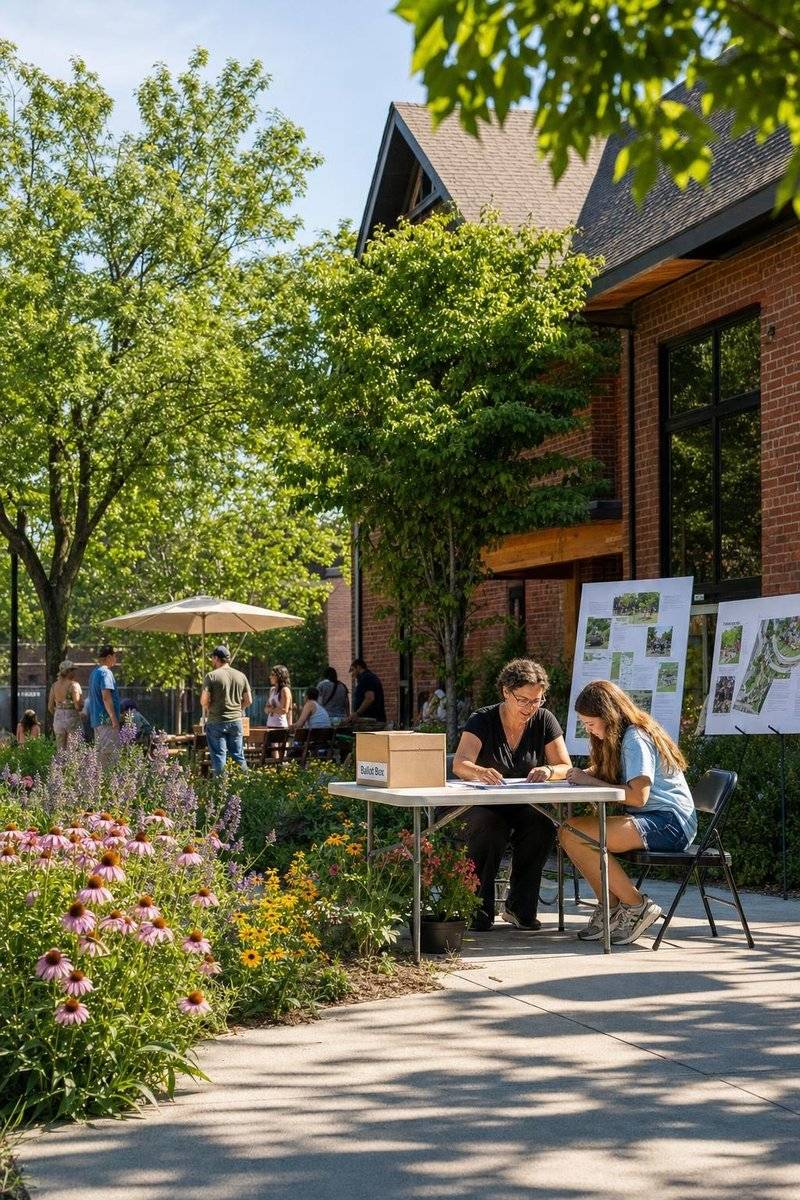
In New York City, an 11-year-old can help decide where a million dollars of public money goes. Residents of participating council districts as young as 11 can pitch ideas and vote, with no citizenship requirement. What is participatory budgeting, then? A process in which community members, including many who cannot vote in ordinary elections, decide directly how to spend part of a public budget.
The Participatory Budgeting Project, a nonprofit founded in 2009 to support the practice in the United States and Canada, uses almost exactly that definition. The key words are "decide" and "part." Residents do not advise, and they do not control the whole budget. They make binding choices about a defined slice of it.
01Where it came from
Participatory budgeting began in Porto Alegre, a city in southern Brazil, in 1989. The Workers' Party had just won city hall, and Mayor Olívio Dutra introduced neighborhood assemblies where residents could set spending priorities. The process drew international attention, including from the World Bank, which pointed to improvements in services such as water access during its first years.
From Brazil the idea spread to hundreds of cities in Latin America and Europe. Chicago's 49th Ward brought it to the United States in 2009, when Alderman Joe Moore put his ward's discretionary capital funds up for a public vote. New York City followed in 2011, and Vallejo, California became the first US city to run it citywide in 2012.
02How the participatory budgeting process works
The details vary, but most participatory budgeting cycles follow the same five stages over roughly a year.
Designing the rules
A steering committee of residents and community groups, working with city staff, writes a rulebook. It sets how much money is on the table, who can vote, what kinds of projects qualify and how long each stage lasts. This stage is easy to skip and costly to get wrong.
Collecting ideas
Residents suggest projects at public meetings, online and through outreach at schools, libraries and senior centers. Anyone can submit an idea, and many processes collect hundreds or thousands of them. Cambridge, Massachusetts has gathered more than 11,000 ideas across its cycles since 2014.
Turning ideas into proposals
Volunteers, usually called budget delegates, sort the ideas, group similar ones and work with city agencies to check feasibility and cost. A suggestion for "a better playground" becomes a specific proposal: replace the equipment at a named park, estimated at a given amount, buildable within the city's rules.
Voting
Residents vote on the final ballot, typically choosing several projects each. Voting often runs for a week or more, both in person and online. Many processes lower the voting age and drop citizenship requirements. Cambridge allows residents from age 12, New York from 11.
Building and monitoring
The city funds the winning projects in its next budget and builds them. Good processes report progress publicly, since a project that takes years to appear can sour residents on the next cycle.
03What is eligible: the kinds of projects that qualify
Most US processes use capital funds, which pay for physical things with a long useful life: playground renovations, park improvements, school technology, library upgrades, street trees, bus shelters, bathroom repairs in public buildings. Capital rules exclude salaries and ongoing programs.
Some processes use expense funding instead, which can pay for programs and services such as youth workshops or job training. New York's citywide process, The People's Money, is run by the Civic Engagement Commission with expense money from the mayor's budget, so the winning ideas are programs carried out by community organizations.
04Benefits and limits
Supporters point to several advantages. The process brings in people who rarely engage with government, including young people and immigrants who cannot vote in elections. It makes the budget visible, since budget delegates learn what things actually cost. It often surfaces needs that officials missed, like a school bathroom nobody had fixed.
The disadvantages are real too. The sums involved are usually a small share of total spending. The process takes a lot of staff and volunteer time. Turnout can be low and skewed toward people who already participate. And when winning projects are delayed, trust drops quickly. Porto Alegre itself later suspended the process that made it famous.
A fair reading is that the process works best as one tool among several, with a modest budget, a city that commits in advance to fund the winners, and enough outreach to reach residents who would otherwise stay home.
05How it differs from other ways of funding local projects
Participatory budgeting allocates public money that already exists. Residents choose; taxpayers pay. Civic crowdfunding works the other way: residents add new money to a specific project the city has approved. When Central Falls, Rhode Island needed new trash and recycling bins for Jenks Park after its bankruptcy, the money came from 63 individual backers, not from a budget vote. Both are forms of residents shaping public space, and the guide to civic crowdfunding covers the second in detail.
For case studies from Brazil to Boston, see participatory budgeting examples. For New York's two programs and how to take part, see participatory budgeting in NYC.
FAQ
What is participatory budgeting in simple terms?
Participatory budgeting is a process in which residents decide how to spend a set part of a public budget. People suggest ideas, volunteers develop them into costed proposals with help from city staff, and the community votes. The government then funds the projects that won. It started in Porto Alegre, Brazil in 1989 and is now used in cities around the world.
Who can vote in participatory budgeting?
Rules are set locally, but most processes are broader than regular elections. New York City Council districts allow residents aged 11 and older to vote, and Cambridge, Massachusetts allows residents from age 12, in both cases regardless of citizenship. Voters usually need to live in the district or city running the process, and some ask for proof of address.
How much money is involved in participatory budgeting?
It varies widely. In New York, each participating council member has pledged at least $1 million from discretionary capital funds. Cambridge started with $500,000 of its capital budget in its first cycle. Paris committed about 5 percent of its investment budget when it launched its process in 2014. In most cities, it is a small share of total spending.
What are the disadvantages of participatory budgeting?
The main criticisms are that the amounts are small relative to the full budget, that the process demands a lot of staff and volunteer time, that turnout can be low or uneven across neighborhoods, and that slow delivery of winning projects can damage trust. Some processes, including Porto Alegre's, were later suspended or scaled back.
Is participatory budgeting binding?
In most programs, yes, in the sense that the city or council member commits in advance to fund the projects that win the vote, subject to legal and technical review. The commitment is usually political rather than legal, so its strength depends on the officials involved. Winning projects still go through normal procurement and construction, which can take years.