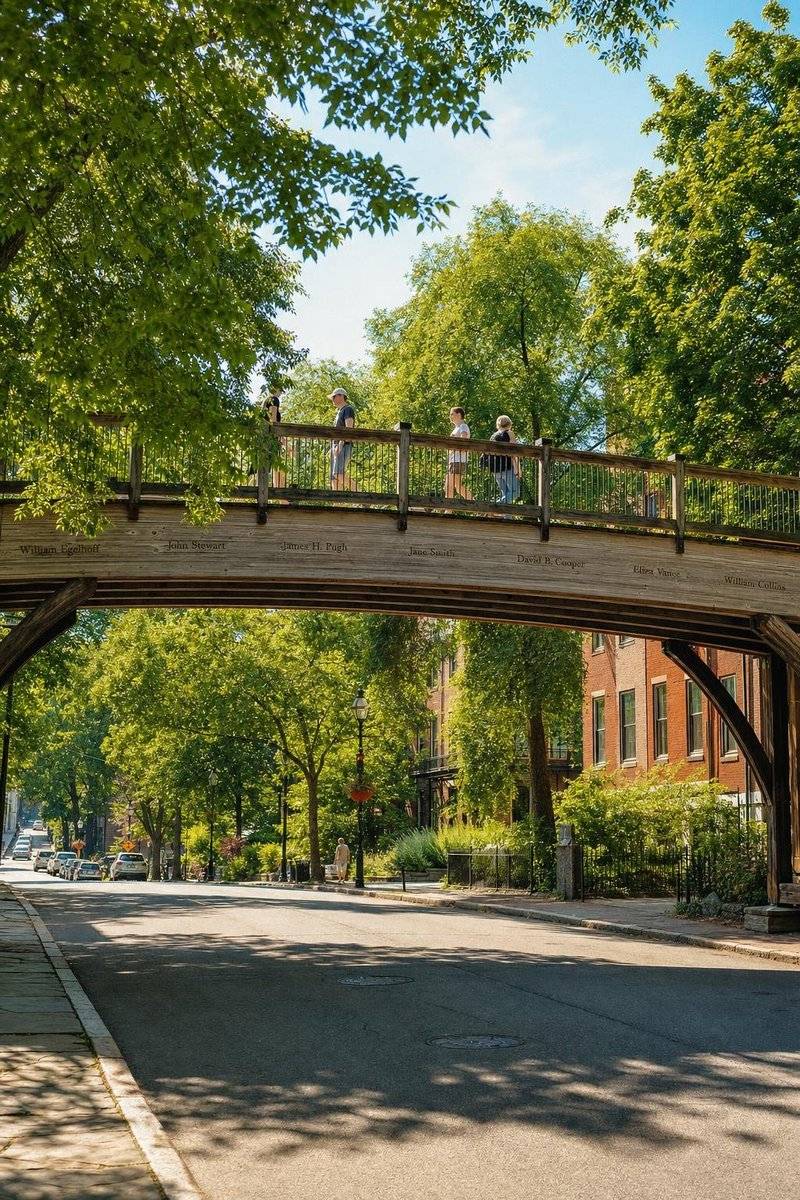
Walk across the Luchtsingel in Rotterdam and you are stepping on names. The yellow wooden footbridge, designed by the local architecture firm ZUS, links parts of central Rotterdam separated by busy roads and a railway. Through a campaign called I Make Rotterdam, anyone could pay 25 euros for a plank and have a name carved into it. Thousands did. The city added public money after the project won its Rotterdam City Initiative competition in 2012, and the full bridge opened in 2015. It is often described as the first piece of public infrastructure paid for in part by the crowd, and it is the cleanest image of what civic crowdfunding means: residents paying directly, and visibly, for a piece of their city.
The idea is simple. A public project, usually on public land and usually approved by the government, raises some or all of its cost from many small online donations. The government builds or maintains it. Donors get nothing back except the thing itself, and sometimes a name on a plank.
01A short history
Crowdfunding for creative projects took off in the late 2000s. Civic crowdfunding, aimed specifically at public spaces, followed around 2012.
In the UK, Spacehive launched that year and presented itself as the first crowdfunding platform built for civic projects. Its model put community groups, councils and businesses on the same page: a project listed its full cost, and anyone (a resident, a company, a local authority) could pledge toward it. London's mayor later created a civic crowdfunding program on Spacehive that offered pledges of up to £20,000 to projects that showed local support. One of the best known was the Peckham Coal Line, a proposal to turn disused coal sidings beside a railway in south London into a raised linear park about 900 meters long. Its campaign for a feasibility study raised more than £75,000 from over 900 backers, with a pledge from the mayor's program.
In the United States, ioby (short for "in our backyards") was incorporated in New York in 2007 and launched in 2009 as a nonprofit crowdfunding site for neighborhood projects: gardens, street murals, bike repair stations, block cleanups. It worked closely with cities and foundations on match programs that added a dollar for every dollar raised. The organization announced in 2024 that it was closing.
Many US cities in the early and mid-2010s also ran online campaigns for specific municipal projects, with the money going into a dedicated city fund. The campaigns covered dog parks, playgrounds, street trees, statues and festivals.
02How a civic crowdfunding campaign works
Most campaigns share a few features.
A public owner signs off first. The city, park district or school agrees in advance that the project can be built and that donations will be used only for it. Without that, donors are funding a wish.
A precise budget. The best campaigns list exactly what the money buys. In Fort Lauderdale in 2015, the Holiday Park dog park campaign laid out a 38,515-square-foot large-dog area and a 22,825-square-foot small-dog area with water stations, benches and bike racks, and explained that donations would go into a special city fund for the park.
All-or-nothing pledges. Many civic campaigns collect pledges only if the full goal is reached by a deadline. If it is not, nobody is charged. That protects donors from paying for half a playground, and it pushes organizers to set realistic goals.
Public money alongside private. Most successful campaigns combine resident gifts with city money, grants or sponsors. In Naperville, Illinois, the city and the public art group Century Walk each committed $25,000 before residents were asked to fund the rest of a plaza for The Spirit of the American Navy, a sculpture by E.M. Viquesney. The campaign reached its $77,000 goal.
Tax treatment. In the US, gifts to a government body for exclusively public purposes are generally deductible under Section 170(c)(1) of the Internal Revenue Code, which lets cities accept donations directly.
03Why cities tried it
For cities, civic crowdfunding was partly a response to tight budgets after the 2008 recession. Central Falls, Rhode Island had gone through Chapter 9 bankruptcy in 2011 and had little capital money left for small improvements. In 2013 the city worked with the Providence nonprofit The Steel Yard on five sturdy combination trash and recycling bins for Jenks Park, its main green space, and 63 residents and supporters pledged almost the whole cost. The Jenks Park bins were a small purchase, but they showed residents that the city was willing to act on a visible problem.
Crowdfunding also works as a demand test. If a few hundred residents will pay toward a dog park, the parks department knows the park will be used.
04The criticisms
Civic crowdfunding has thoughtful critics, and their points deserve a fair hearing.
The first is equity. Wealthier neighborhoods can raise money faster, so a city that relies on crowdfunding may end up with nicer parks where people already have more. Match programs that favor lower-income areas are one response.
The second is responsibility. If residents pay for playgrounds, will councils stop budgeting for them? Supporters answer that most crowdfunded projects are extras the budget would never have covered, but the concern is reasonable.
The third is maintenance. A crowd can pay for a bench once. It rarely pays to repair it for twenty years. Projects with a clear maintenance owner hold up better.
And there is the plain question of results. Many campaigns fell short. In Chickasha, Oklahoma, a 2014 campaign for the Centennial Park playground showed about $187,000 pledged toward a $293,000 goal a month before its June 2014 deadline. Partial outcomes like that are common, which is one reason many cities moved to phased goals.
A side note on the Luchtsingel: within a decade of opening, the bridge's future was already under discussion in Rotterdam, with debate over whether to restore or remove it. Crowdfunded or not, public infrastructure ages like any other.
05Where civic crowdfunding fits
Civic crowdfunding is best understood as one tool among several. It adds new money to specific projects, while participatory budgeting lets residents allocate money the city already has. Grants, covered in our community grants guide, often provide the larger share. And the classic local formats in community fundraising ideas, from matched gifts to sponsored benches, still do much of the work offline.
FAQ
What is civic crowdfunding?
Civic crowdfunding is the practice of raising money online from many individual donors for a public project, such as a park, playground, bridge, garden or public art. Usually the project is approved by a city or public agency, which builds or maintains it. The model spread around 2012, with platforms such as Spacehive in the UK and ioby in the United States.
Is civic crowdfunding the same as participatory budgeting?
No. Participatory budgeting lets residents vote on how to spend public money the government already has. Civic crowdfunding asks residents to add new money of their own to a specific project. The two can work together: a city might use participatory budgeting to pick priorities and crowdfunding to cover extras the budget cannot reach.
Are donations to civic crowdfunding projects tax deductible?
In the US, gifts made to a city or other government body for exclusively public purposes are generally deductible under Section 170(c)(1) of the Internal Revenue Code. Gifts to a registered 501(c)(3) partner usually are too. Gifts to an informal group may not be. Donors should check where the money goes and confirm with a tax professional.
What happens if a civic crowdfunding campaign does not reach its goal?
It depends on the campaign rules. In an all-or-nothing campaign, pledges are not collected and donors pay nothing. In a flexible campaign, the organizers keep what was raised and use it toward the project or a smaller first phase. Organizers should state the rule clearly at the start, along with what happens to any surplus.
What are the main criticisms of civic crowdfunding?
Critics worry that wealthier neighborhoods can raise money more easily, widening gaps between areas, and that governments may come to rely on donations for things they should fund themselves. Others point out that crowdfunded projects still need long-term maintenance from public budgets. Match programs aimed at lower-income neighborhoods and clear maintenance agreements are common responses.