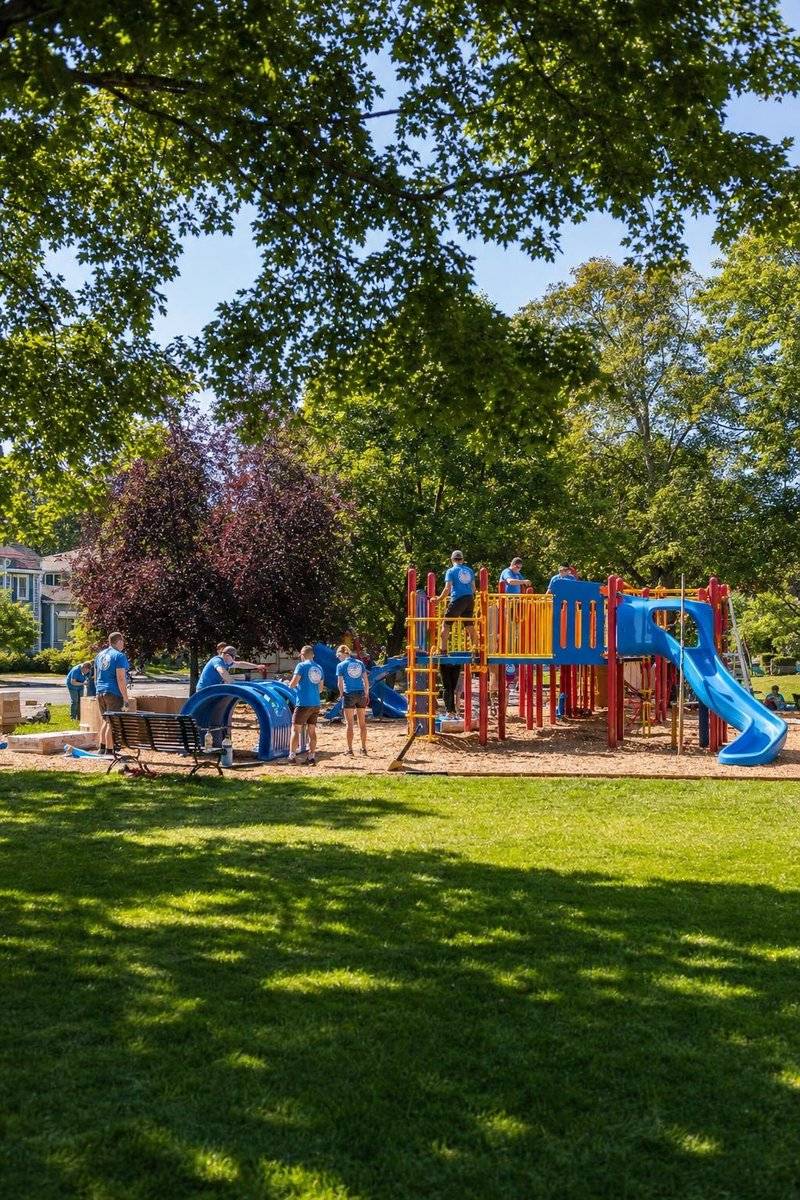
Nash Field in Chicopee, Massachusetts was dedicated in 1925 in Willimansett, an old mill village on the Connecticut River. For decades its play equipment amounted to some swings and a single slide. When the city and a local group called Team Chicopee wanted something better, they asked children at the nearby Boys & Girls Club to draw what they would like to play on, then applied to KaBOOM! and won a $20,000 construction grant. The catch: the grant required $30,000 in total equipment spending. The city committed $5,000 and residents raised the last $5,400.
That is how playground grants usually work. They are rarely the whole budget. They are the anchor that makes the rest of the money easier to find.
01Why playgrounds need outside money
Playground equipment wears out, and older wooden structures in particular tend to fail safety inspections. City parks departments usually cannot replace them all on schedule. In Chickasha, Oklahoma, the Kids Place playground in Centennial Park was demolished because of unsafe features, wear, vandalism and an outdated wood system with thin wood-fiber surfacing. The city's parks department said plainly that it worked within a limited budget and could not replace aging equipment in a timely way.
In Canton, North Carolina, the recreation commission explained the same pressure from another angle. Money that could have gone to playgrounds was going to street repairs and police and fire protection, which most residents would rank higher. So the commission went looking for sponsorships, donated materials and labor, starting with parts to repair a single tunnel slide.
02The main playground grant sources
KaBOOM! The Washington-based nonprofit, founded in 1996, is the best-known national playground funder. Its model is the community build: residents and children help design the space, and volunteers assemble it on a build day alongside a KaBOOM! project manager. It has offered grants both for builds it leads and for communities that build on their own. Eligible applicants have generally been municipalities, schools and child-serving nonprofits that either lack a playground or have unsafe equipment, and that own the land or have permission to build. Corporate partners fund most rounds, so grant names and amounts change.
Community Development Block Grants. HUD's CDBG program lists parks and playgrounds among eligible public facilities. Chickasha's renovation drew on the city's own money plus a CDBG award, together about $185,000, for new equipment, a security system and lighting. Because CDBG money is allocated by your city or county, ask the community development office, not HUD.
State recreation grants and LWCF. State parks agencies distribute Land and Water Conservation Fund money as 50:50 matching grants for outdoor recreation, and many states add their own park grant programs. These go to municipalities and can fund playgrounds as part of a larger park project.
Local foundations and businesses. Community foundations, hospitals, banks and local employers often sponsor playgrounds, sometimes with naming rights for a piece of equipment.
03Safety and accessibility rules shape the budget
A playground grant budget is not just equipment. Two sets of standards drive the real cost.
The first is safety. The U.S. Consumer Product Safety Commission publishes the Public Playground Safety Handbook, and most manufacturers build to ASTM F1487, the standard for public playground equipment. Both put heavy weight on fall zones and impact-absorbing surfacing. Chickasha's first phase budgeted specifically for "fall zone material," and that line is often among the biggest.
The second is access. The 2010 ADA Standards for Accessible Design include requirements for play areas, such as accessible routes and a share of ground-level play components that children using wheelchairs can reach. Inclusive playgrounds go further, with equipment designed for children of all abilities to play together, and they cost more. Funders increasingly favor them.
04Building the local share
Most playground projects need local money on top of grants. Three approaches recur.
Phasing. Chickasha's committee split its work into a first phase (the play system, surfacing and amenities around the playground) and a second phase (a shelter, parking, landscaping). The Centennial Park playground campaign in 2014 asked the community for the first phase and showed the second as coming later.
Matching. A grant with a match requirement turns every local gift into a lever. In Chicopee, the $5,400 raised by 52 backers released a $20,000 national grant and $5,000 from the city. Naturally Nash! is the clearest small-town example of that math.
Asking children. It sounds sentimental, but it works. Designs that come from children's drawings make better fundraising material than a catalogue photo, and they keep the project focused on what kids will actually use.
For general grant strategy, see community grants. For fundraising formats, community fundraising ideas collects what has worked for public projects. If your project includes a fenced area for dogs next to the playground, see how to build a dog park.
A small observation from the Chickasha campaign page: it described Centennial Park as drawing joggers, walkers, sports teams, dog owners and school children from across Grady County. A playground in a park that busy is easy to defend in a grant application. One tucked in a corner nobody visits is not.
FAQ
Who can apply for playground grants?
Most playground grants go to municipalities, public schools and nonprofits that serve children. KaBOOM! programs, for example, have generally required applicants to own the land or have permission to build, and to lack a safe playground. Neighborhood groups without nonprofit status usually apply through a school, the parks department or a partner organization that can accept the grant and sign the agreement.
How much does a public playground cost?
Costs vary widely with size, materials and accessibility. In 2014, Chickasha, Oklahoma combined about $185,000 in city and CDBG funds with a community campaign for a single park playground, including surfacing, lighting and security. A small repair can cost a few hundred dollars, as with the tunnel slide parts in Canton, North Carolina. Get vendor quotes that include surfacing, installation and accessibility features.
Do playground grants cover installation?
Some do and some do not. Community-build grants like those from KaBOOM! rely on volunteers for assembly, which lowers installation costs but requires organizing a large crew. Other grants pay only for equipment, leaving site preparation, surfacing and professional installation to the applicant. Read the grant terms carefully and price every line before you announce a fundraising goal.
Are there grants for inclusive or accessible playgrounds?
Yes. Many foundations and state programs give priority to playgrounds that go beyond the minimum ADA requirements and serve children of all abilities. These projects cost more because of specialized equipment and unitary surfacing such as poured rubber. Local disability organizations and children's hospitals are useful partners, both for design advice and for support letters.
What is a community-build playground?
A community-build playground is assembled largely by volunteers, often in a day or a few days, after residents and children help plan and design it. KaBOOM! popularized the model in the United States. The approach cuts labor costs and builds a sense of ownership, which tends to mean fewer problems with vandalism and more neighbors watching over the new equipment.