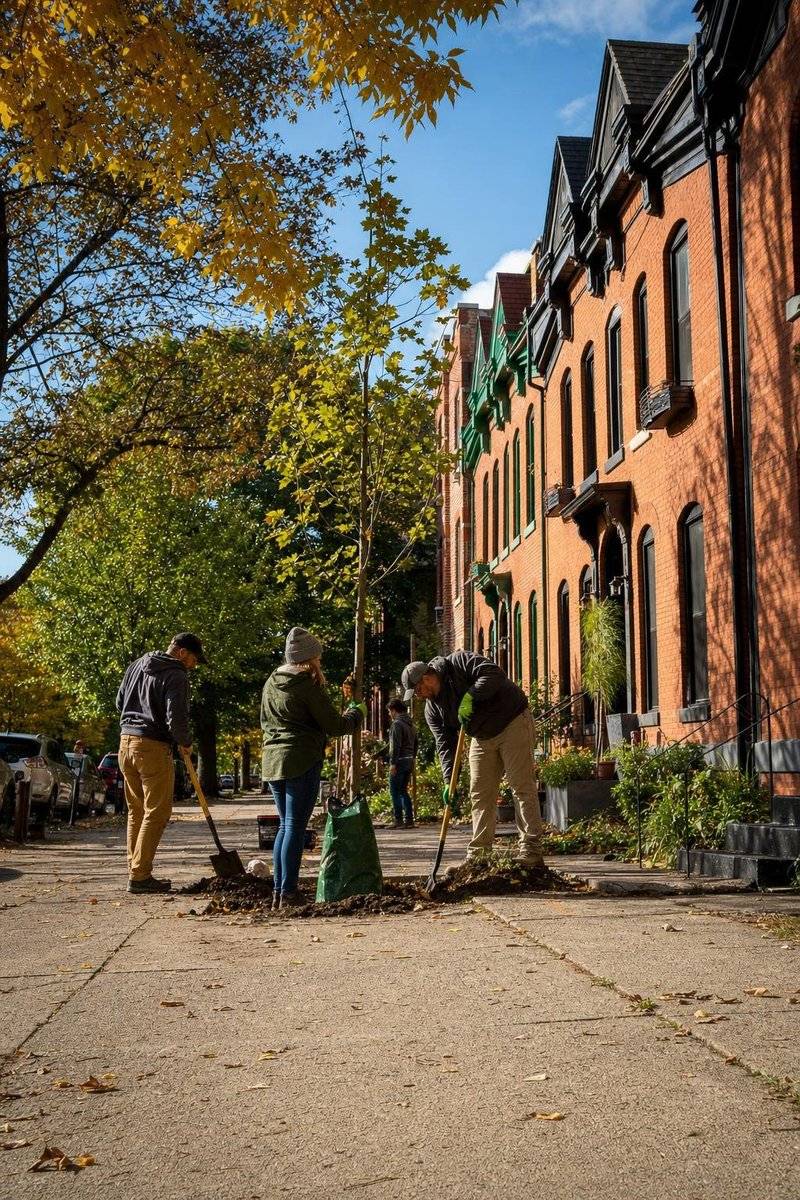
Middletown, Ohio has about 30 city parks. By early 2016 those parks had lost more than 200 ash trees to the emerald ash borer, a beetle from Asia that has killed ash trees across the Midwest since it was first found near Detroit in 2002. The city's Public Works Department picked ten replacement species, from bur oak and American beech to eastern redbud and serviceberry, named the ten parks where they would go, and asked residents to help pay. That is the usual shape of tree planting grants and campaigns in American towns: a loss, a list of species, and a request for money that the regular budget does not cover.
Tree money is easier to find than playground money in one respect. A single tree is cheap enough for one donor, and the benefits (shade, cooler streets, less stormwater) are easy to explain. The harder part is the years of watering that follow.
01What a new tree really costs
The best breakdown we have seen came from a neighborhood group in Alexandria, Virginia in 2014. For each tree in Four Mile Run Park it budgeted about $380: roughly $100 for the tree itself at 1.5-inch caliper, $25 to $30 for a watering bag and staking, and as much as $12.50 per watering, twenty times a year, for two years. Volunteers did the planting. The Four Mile Run Park tree planting shows why watering, not the sapling, is the largest line in most tree budgets.
Larger trees cost more. Evanston, Illinois planned to buy at least twenty-five trees of 2.5-inch diameter from local nurseries with $6,480.
02Federal money: the Urban and Community Forestry Program
The USDA Forest Service's Urban and Community Forestry Program is the main federal source for city trees. It works mostly through state forestry agencies, each with an urban forestry coordinator who distributes federal money to towns, nonprofits and tribes as grants and technical help.
The program grew sharply after the Inflation Reduction Act of 2022 set aside $1.5 billion for it over ten years. In April 2023 the Forest Service opened a $1 billion grant competition. In September it announced awards for 385 projects in all 50 states, chosen from 842 applications that together asked for about $6.4 billion. The gap between requests and awards tells you something about demand.
For a neighborhood group, the practical door is the state urban forestry coordinator. Ask which programs are open, whether your city already has a grant you can join, and whether volunteer labor counts as a match.
03Tree City USA and why it matters for grants
Tree City USA is a recognition program run by the Arbor Day Foundation with the National Association of State Foresters. A town qualifies by meeting four standards: a tree board or department, a public tree care ordinance, a community forestry budget of at least $2 per capita, and an Arbor Day observance with a proclamation.
The designation itself pays nothing. But the four standards are exactly what most tree grant reviewers want to see: someone responsible, rules for public trees, steady spending and public support. If your town is not one, helping it qualify is a worthwhile first project.
04City programs and giveaways
Many cities run their own planting programs, often with a nonprofit partner.
Philadelphia's TreePhilly, launched in 2012 by Philadelphia Parks and Recreation with the Fairmount Park Conservancy, gives free yard trees to residents who agree to plant and care for them. Its first-year goal was 15,000 trees, part of the city's Greenworks plan to plant 300,000 by 2015. A fall campaign that year aimed to raise money for trees that residents would pick up two at a time, along with instructions for planting. The Philadelphia fall tree planting campaign raised about $1,700 from 45 backers toward a much larger goal, which is a reminder that big round targets are harder to fill than small specific ones.
Evanston took a different route. Volunteers known as TreeKeepers, trained through the Chicago-area conservation group Openlands, had been helping the city mulch park trees and pull invasive buckthorn. As Dutch elm disease and the emerald ash borer took thousands of park and parkway trees, the city started "I Heart Evanston Trees" to involve residents. Its campaign was funded in full by 43 backers, with a stated plan to plant a wide mix of native species so the next generation of trees would be more resilient to pests. I Heart Evanston Trees is a good model of species diversity written into a fundraising ask.
Memorial and tribute programs are another steady source. Middletown's Public Works Department offered a Memorial Tree Program, a tree with a commemorative plaque planted in a city park. Many cities run similar programs, and they bring in money year after year without a campaign.
05Writing a strong tree grant request
Grant reviewers look for a few specific things.
Name the species and say why. Diverse plantings resist pests. A list like Middletown's ten species is more convincing than "native trees."
Show the site. Street trees need a tree pit or planting strip of adequate size and clearance from utilities. Park trees need room for a mature canopy.
Budget the watering. Two to three years of establishment care is standard. Say who does it, whether volunteers with watering bags, a city crew or a contractor.
Include maintenance after establishment. Pruning and eventual removal are city costs; say that the city has agreed to them.
Timing is its own small puzzle. Fall is planting season across much of the country, which is why so many campaigns, from Philadelphia to Alexandria, were framed as fall plantings. A grant awarded in late spring often means a tree in the ground the following autumn.
For broader grant strategy, see community grants. For campaign formats that suit trees particularly well, like per-tree pricing and memorial gifts, see community fundraising ideas.
FAQ
Who offers tree planting grants?
The USDA Forest Service's Urban and Community Forestry Program is the main federal source, usually distributed through state forestry agencies. Many states run their own urban forestry grants. Cities, utilities, community foundations and nonprofits such as the Arbor Day Foundation also support planting. For neighborhood groups, the city forester or the state urban forestry coordinator is the best first contact.
Can residents get free trees from their city?
Many cities run giveaway programs. Philadelphia's TreePhilly, launched in 2012, gives free yard trees to residents who commit to planting and caring for them. Other cities offer free or low-cost street trees if residents request one for the planting strip in front of their home. Ask your city's parks, forestry or public works department what is available.
How much does it cost to plant a tree in a park?
A 2014 budget from Alexandria, Virginia put the total at about $380 per tree: around $100 for a sapling of 1.5-inch caliper, $25 to $30 for staking and a watering bag, and the rest for two years of watering. Bigger trees, professional planting or street sites that need concrete cut out cost more. Ask your city forester for local prices.
What is Tree City USA?
Tree City USA is a recognition program from the Arbor Day Foundation and the National Association of State Foresters. Towns qualify by having a tree board or department, a public tree care ordinance, a community forestry budget of at least $2 per capita, and an official Arbor Day observance. The designation does not come with money, but it signals to funders that a town manages its trees responsibly.
Do tree planting grants cover watering and maintenance?
Some do, especially those that require proof that trees survive. Many grants cover only the purchase and planting, leaving establishment watering to the applicant. Since watering for two or more years can cost more than the tree, plan for it from the start. Volunteer watering crews, watering bags and agreements with city crews are common solutions.