"Litter is not normal." That was the line at the center of a short civic idea posted for Philadelphia, written by a neighborhood group fed up with trash blowing along its business corridor and into the storm drains.
The idea, titled Litter B Gone, was liked 29 times and ranked first among Philadelphia ideas by 2016. The text itself dates from 2013. It asked for something specific: solar compacting trash receptacles, each paired with a matching recycling bin.
The problem on the corridor
Philadelphia has a long history with street litter. Many of its commercial corridors are lined with small storefronts, takeout counters and bus stops, and the old wire litter baskets that once stood on corners overflowed quickly. When a basket is full, trash goes on the ground, and from the ground it goes into the gutter and then into the sewer system, which in older parts of the city carries stormwater and sewage together.
The group behind the idea described itself as a civic association whose mission was to improve quality of life by encouraging civic involvement, promoting neighborhood activities and serving residents and businesses. Its stated vision was neighbors working together for a common goal: a clean, green, safe community.
What the idea asked for
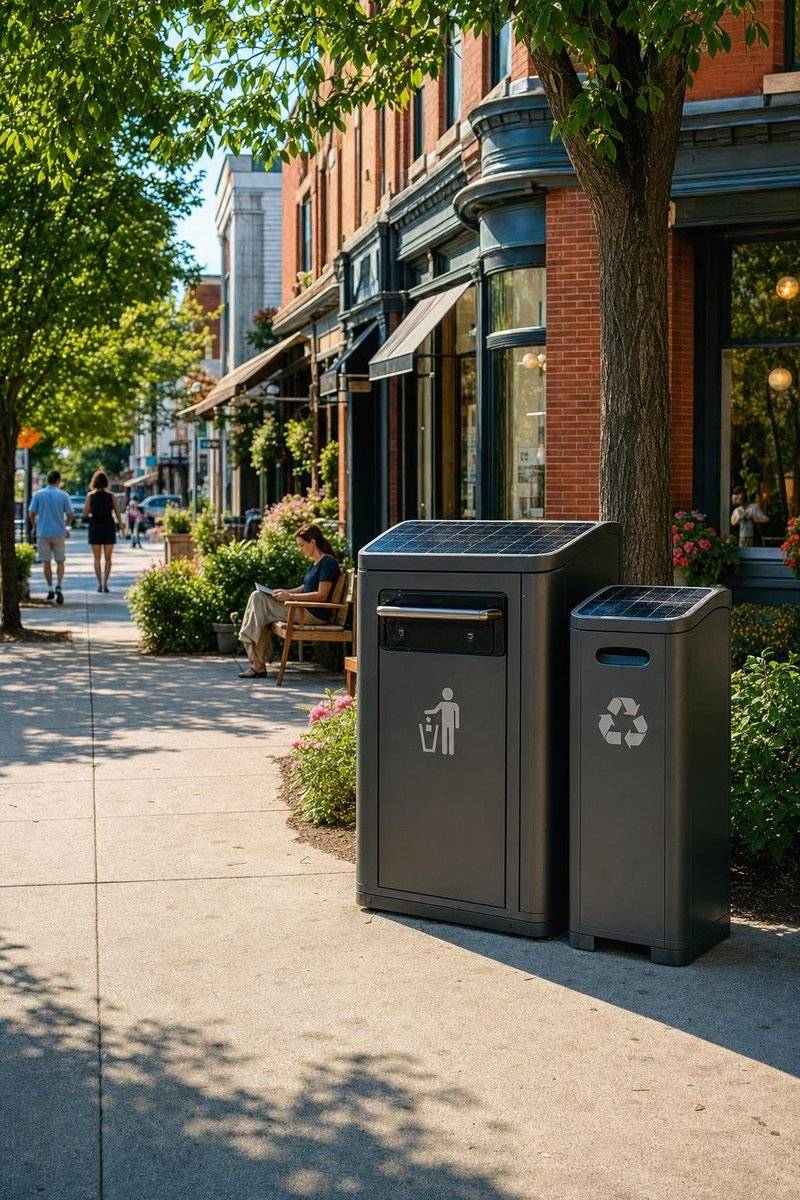
The proposal was for solar-powered compacting bins. These units use a small solar panel to run a compactor that squeezes trash down as it fills, so a single bin holds several times the volume of an ordinary basket. They also send a signal when they are full, so collection crews can come when needed instead of on a fixed route.
Next to each one would sit a recycling container. The authors argued that bottles, plastic and paper had value to the city and should not end up in a drain simply because there was nowhere to put them.
There was a civic twist too. The group wanted its mission, its meeting time and place, and its contact details painted artistically on the containers. Each bin would double as a small billboard for neighborhood involvement, reminding people walking by that someone local was looking after the street.
The idea did not set a dollar goal. Like many petitions of its kind, it was a way to measure support before approaching the city or a funder, a step laid out in the guide on how to propose a project to your city.
Philadelphia already had the bins
The request was less unusual in Philadelphia than it might have been elsewhere. In 2009 the city's Streets Department had begun replacing hundreds of wire litter baskets with BigBelly solar compactors and companion recycling units, starting in Center City. It was one of the largest deployments of the technology in the country at the time.
The early results were striking. A Streets Department official said collections in Center City dropped from seventeen times a week to three, and an EPA case study described a 70 percent reduction in annual operating cost. Workers who had spent their shifts emptying baskets were moved onto household recycling trucks, and the rollout gave the city its first on-street recycling.
Not everyone accepted the savings figures. A review by the City Controller in 2010 noted that the compactors, at about $3,700 each, were bought through a sole-source contract. A follow-up report in 2017 concluded that there was no valid evidence of cost savings from the roughly $6.5 million spent on the program, and estimated annual maintenance at about $260,000. The Streets Department disputed that conclusion and stood by its own cost-benefit analysis.
For a neighborhood group, that history cuts two ways. It shows the bins work well where foot traffic is heavy and pickup routes are expensive. It also shows they are not cheap, and that a group buying its own units would be taking on a piece of equipment the city has to service.
Paying for bins outside the city plan
Neighborhood groups in Philadelphia have usually reached bins like these through business improvement districts, special services districts or grants, rather than by buying units outright. A typical route is for a corridor organization to raise part of the cost and ask the Streets Department or a council office to cover the rest and add the bins to city collection. The guide to community grants describes where that kind of matching money tends to come from.
Whether this particular corridor got its solar bins could not be confirmed. The group's argument, though, was the one the Streets Department itself had made in 2009: a full basket makes litter, and a bin that never overflows is cheaper than sweeping up after it.