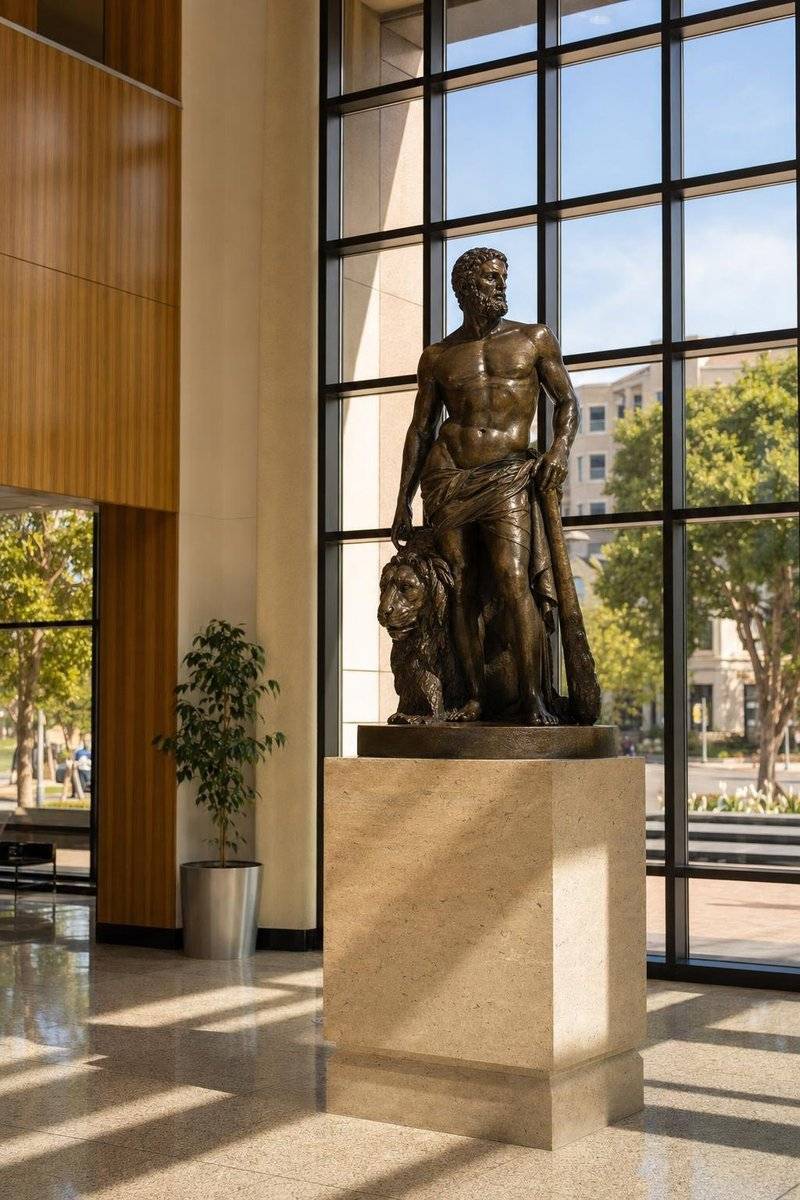
Few American cities are named after a brand of explosive. Hercules, California is one of them, and in early 2016 the city tried to bring home a statue that connects it to that history.
A town built around a powder works
Hercules sits on the shore of San Pablo Bay in western Contra Costa County, about 20 miles northeast of San Francisco. For most of a century the land was dominated by a single industrial plant. A powder works opened on the site in 1881 to make dynamite, and in 1912 it became part of the newly formed Hercules Powder Company, named after its leading product, Hercules black powder.
The town grew around the plant. In 1900 the company's officers incorporated the community as a town, which took its name from the works, and for decades Hercules was a company town in the plain sense: one employer and one purpose.
Chemical production on the site continued until 1977. After that the old plant land was redeveloped, and from the 1970s on Hercules grew into a suburban city of single-family homes. It now has about 25,000 residents and very few physical reminders of the plant that gave it a name.
The sculptor and the commission
Paul Manship was one of the best-known American sculptors of the twentieth century. He is often linked with the Art Deco style, and his gilded Prometheus at Rockefeller Center in New York is among the most recognized public sculptures in the country. He returned many times to the figure of Hercules, modeling the hero in a series of works.
According to the city's account, around 1945 the Hercules Powder Company commissioned Manship to produce two bronze statues of Hercules to mark the company's role in World War II, when its plants produced explosives and propellants for the war effort. The Smithsonian American Art Museum holds a 1945 bronze Hercules by Manship as part of the sculptor's bequest, which fits that timing.
What the city wanted to do
The two original company pieces were not available to the city. What it was offered instead was the chance to acquire, restore and transport a 30-inch posthumous cast of Manship's Hercules, made from the sculpture originally commissioned by the powder company.
The plan had two stages. The statue would go on public display in Hercules City Hall at first. Later it would move to the planned Hercules Regional Intermodal Transportation Center, a transit hub to be built on part of the original powder works site, near the waterfront. There it would greet people arriving and leaving the city, on the same ground where the company had operated.
The goal was $10,800, which included fees. That covered the purchase, restoration and transport of the cast. Contributions to a city for a public purpose are generally tax-deductible as charitable gifts, which the campaign noted, and pledges would only be charged if the full goal was reached.
How the campaign stood
By March 2016, nine backers had pledged $2,450, with three days left. That is well short of the goal at the final stretch, and no source could be found confirming that the cast was later acquired by other means or installed at City Hall.
Public art acquisitions like this often take another route when crowdfunding falls short. Hercules has an Art in Public Places program, adopted by ordinance in 2010, which governs how public art is placed and funded in the city, and cities with such programs sometimes cover a gap through a dedicated art fund, a local foundation or a sponsor. The guide to civic crowdfunding looks at why small cultural projects can struggle to reach their goals even when the story is strong.
The transit center
The second home planned for the statue was itself a long-running project. The Hercules Regional Intermodal Transportation Center was planned as a waterfront hub on the old industrial land by the shoreline, linking regional rail, buses and, in the longer-range plans, ferry service. Projects of that size move forward in pieces and depend on state and regional transportation money.
A statue of the company's namesake hero, standing at the spot where its workers once came and went, was a neat idea. Whether it ever stands there is still an open point.