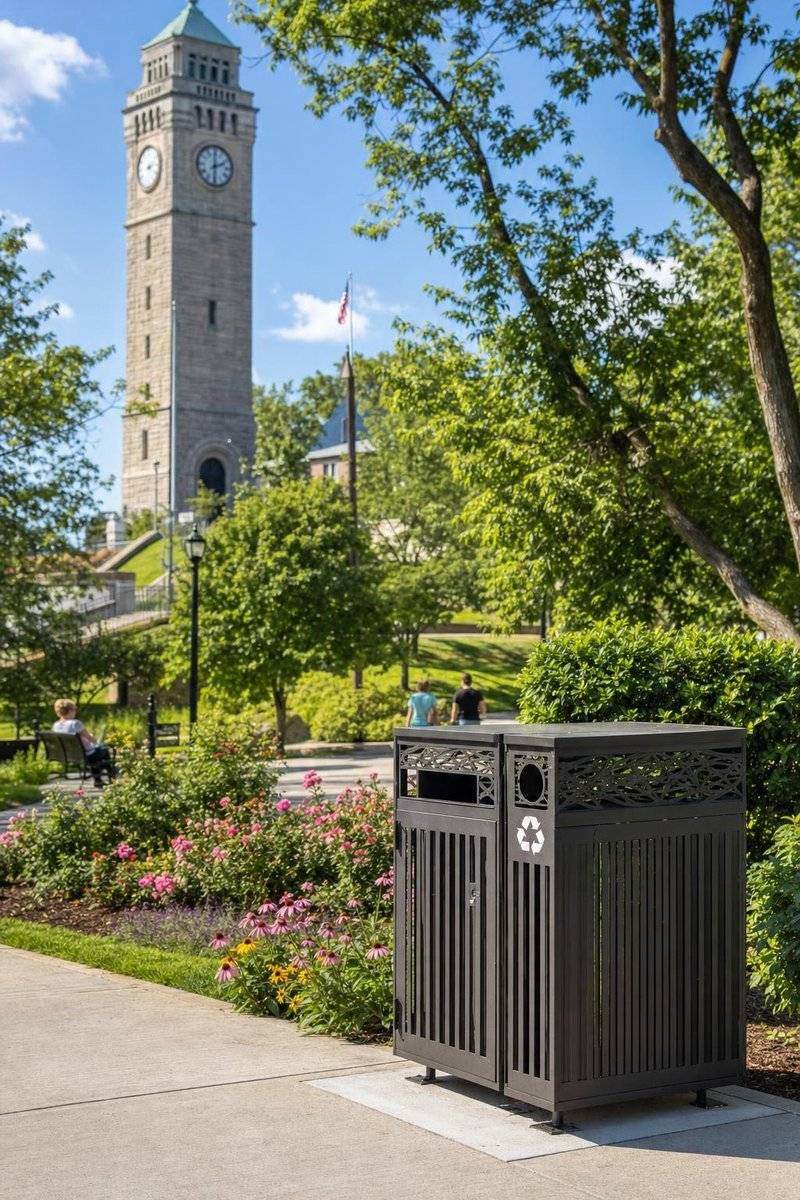
Central Falls covers about one square mile. It is the smallest city in the smallest state, and close to 20,000 people live inside its borders, which makes it one of the most densely populated places in the United States. Green space is scarce. That is why the state of a single park, and the trash cans in it, became a citywide project in late 2013.
A city coming out of bankruptcy
Central Falls sits on the Blackstone River just north of Providence and Pawtucket. It grew as a mill town during the American Industrial Revolution, and generations of immigrants came to work in its factories. In the 2010 census it became the first Hispanic-majority community in Rhode Island.
The city had a hard recession. It consistently recorded the state's highest poverty and unemployment rates and its lowest incomes. In August 2011 Central Falls filed for Chapter 9 bankruptcy, the first city in Rhode Island ever to do so and one of only a handful in the country. The process ended in 2012, but it left the city short of staff and with many projects unfunded. Mayor James Diossa, elected in 2012, took office facing those constraints.
The problem in Jenks Park
Jenks Park is the city's centerpiece public park, set on a rocky hill near the center of town and known for its stone observation tower, Cogswell Tower. It is one of the few places in Central Falls where families can spend time outdoors on grass and under trees.
It also had a litter problem. The only trash cans were cheap plastic bins that tipped over easily, scattering garbage across the paths and lawns. There was no recycling at all. City staff spent extra time cleaning up after spills, and the debris was both an eyesore and a hazard for the children who played there every day.
The solution: bins as public art
The city teamed up with The Steel Yard, a nonprofit industrial arts center in Providence that designs and fabricates functional public art, such as benches, bike racks and trash cans for public spaces. Together they planned five new combination trash and recycling containers for Jenks Park.
The design answered both problems. The bins would be made of heavy steel and anchored into concrete, so they could not tip over. Each would have a recycling compartment, bringing recycling to the park for the first time.
Residents would also have a say in the look. The Steel Yard planned to collect public feedback, then assemble a team of artists to develop design concepts and decorative elements, so each container would be as much a sculpture as a receptacle. The campaign was published in both English and Spanish, reflecting the city's population.
The Steel Yard had a track record with this kind of work. It had designed, fabricated and placed some 100 trash cans around downtown Providence with the Downtown Improvement District, and had installed bike racks at several Central Falls sites, including City Hall and Crossman Park.
The campaign
The goal was $10,044, including fees, for design, fabrication and installation of the five bins. Pledges would be charged only if the full amount was raised. A goal of that size, for five pieces of custom steelwork, is modest. Commercial heavy-duty park receptacles alone can cost several hundred dollars each before installation, and these were to be designed with community input and finished by artists.
The response was strong for a small, low-income city. In December 2013, with 17 days left, 63 backers had pledged $9,909, or about 99 percent of the goal. The final result could not be confirmed. The guide to civic crowdfunding explains how this all-or-nothing model tends to produce a late push when a campaign is that close.
Later work in the park
Jenks Park continued to get attention after 2013. The Jenks Park playground later reopened after a year-long renovation, funded with about $1 million from the Rhode Island Department of Environmental Management. Smaller amenity projects like the bins are the kind of thing that state grant programs rarely cover, which is why cities pair them with local fundraising. The guide to community grants describes how that pairing usually works.
From the top of Cogswell Tower, the whole city is visible at once. One square mile is not much ground, and in a place that small a single park carries a lot of weight.