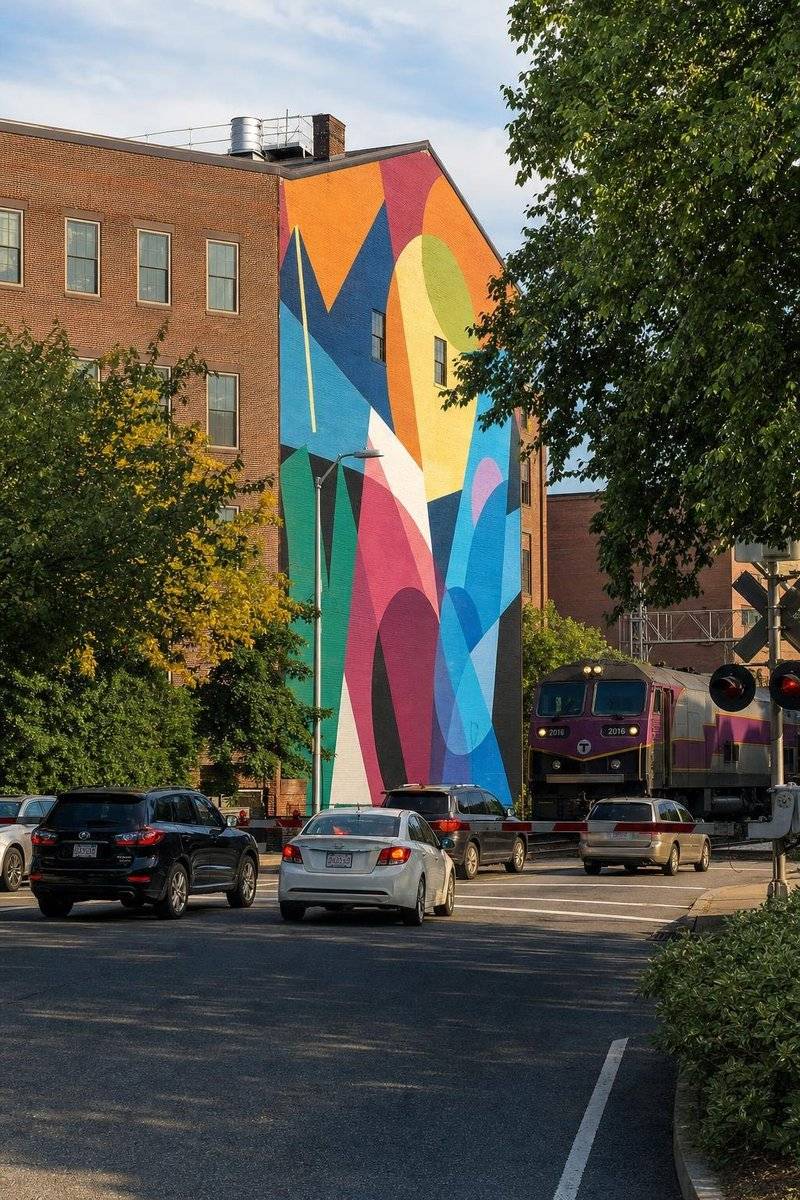
About 8,800 commuter rail riders and 27,000 vehicles passed one downtown Framingham intersection every day in 2014. What they saw there was a rail crossing, worn storefronts and billboards advertising businesses in other towns. A local nonprofit wanted them to see a painting instead.
A downtown built by the railroad
Framingham, about 20 miles west of Boston, grew up around rail. Several lines met in its downtown, serving factories that included Avery Dennison and a General Motors assembly plant. When industry declined from the 1960s onward, the downtown took a second blow as new retail moved north to the highway interchanges along Route 9 and the Massachusetts Turnpike.
Immigrants kept it alive. From the 1980s, an influx of entrepreneurs, many of them Brazilian, opened shops and restaurants in vacant storefronts. By the 2010s the district was starting to reinvent itself, guided by Framingham Downtown Renaissance, a 501(c)(3) nonprofit that brought together the town, local businesses, banks, schools, other nonprofits and artists.
The rail network was still there. The MBTA commuter rail line to Worcester crosses state Routes 126 and 135 right in the center of downtown, at grade, so drivers and pedestrians wait at the gates while trains pass. To Framingham Downtown Renaissance, that crossing was the town's front door, and it looked neglected.
The Front Door Framingham Project
The nonprofit's answer was a large mural on the brick wall of a privately owned building flanking the tracks at the crossing of Routes 126 and 135. The aim was to give downtown a new identity: an image that told everyone passing through that this was a multicultural, creative place worth stopping in.
The artist chosen was Sorin Bica, a Framingham resident and painter with a studio in the Bancroft Building, home to the Fountain Street Studios and the Fountain Street Fine Arts gallery. He also worked in a studio in Boston's SoWa arts district. Framingham was home to a large community of artists, and the group saw the mural as a way to make that visible.
The campaign had letters of support from the local visitors bureau and from the Danforth Art Museum and School, a Framingham institution that later became part of Framingham State University.
The budget
The goal was $27,000. It was meant to cover all of the supplies the artist needed for a wall-sized painting, plus the cost of his labor over months of work. Donations were tax-deductible, and as with any all-or-nothing civic campaign, pledges would only be collected if the full goal was met. The guide to civic crowdfunding explains that model.
By April 2014, 59 backers had pledged $6,543, with 19 days left, roughly a quarter of the goal. The campaign does not appear to have reached its full amount online. A community post on Patch also appealed for donations toward the $27,000.
The mural gets painted
The project went ahead anyway. Bica began painting in August 2015 and worked into the spring of 2016. The finished mural covers the brick wall at 16 Concord Street, beside the commuter rail tracks at the junction of Routes 126 and 135, exactly where the 2014 plan had placed it.
The design is abstract, and Bica and local writers have described it as a reflection of the town's diversity and sense of community. Bica also agreed to come back and restore the work if it was ever damaged, a practical promise for a large painting on an exposed wall beside a railroad.
How the funding gap between the online campaign and the final cost was closed is not documented in the sources found. Projects like this usually draw on a mix of local business sponsors, foundation grants and town or state cultural council money; the guide to community grants covers those sources.
A side note on the wall
Murals beside railways have a particular problem: the people who see them most are moving. Drivers waiting at the gates have a minute or two; train passengers get a few seconds. A large, abstract design reads well at that speed, while a detailed figurative scene might not. Whether by intent or instinct, the Front Door mural was built for exactly that audience.
Framingham itself changed status a few years later, voting to become a city in 2017. The mural at 16 Concord Street was already there to greet the change.