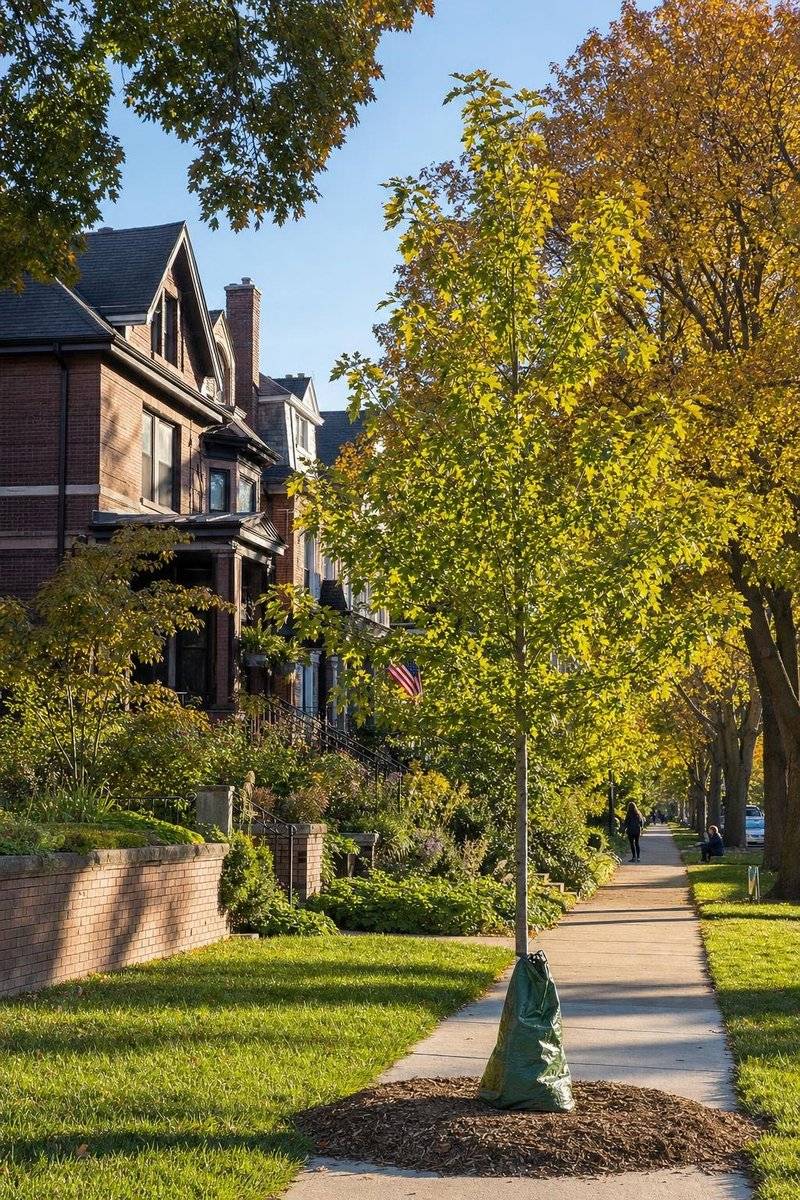
In the summer of 2013, nine ash trees along Sheridan Road in Evanston were painted blue. The paint marked them for removal. They were among the last casualties of a beetle that had already killed more than 2,000 of the city's trees.
That same summer, Evanston asked residents to help pay for replacements.
A city defined by its canopy
Evanston sits on the Lake Michigan shore just north of Chicago, home to Northwestern University and to neighborhoods of large old houses on streets lined with mature trees. Many of those trees grow on the parkways, the strips of grass between sidewalk and curb, which belong to the city. Some trees in the city's parks and older neighborhoods predate the town itself.
For residents, trees are not just scenery. They shade whole blocks, and in some families the same tree has stood in front of the house for generations.
Two invasions
Evanston lost its first big wave of trees to Dutch elm disease, a fungal disease spread by bark beetles that swept through American cities from the mid-twentieth century and wiped out elm-lined streets across the Midwest.
The second wave was the emerald ash borer. This metallic green beetle, native to Asia, was first found in the Detroit area in 2002 and reached Evanston by 2006. Its larvae tunnel under the bark of ash trees and cut off the flow of water and nutrients, killing most infested trees within a few years. Ash had been one of the go-to street trees after the elms died, so cities that had replanted with ash were hit twice.
By 2013 the borer had destroyed more than 2,000 of Evanston's trees, and the city's Parks and Forestry Division was still taking dead ash down.
Volunteers, then the city
The replanting effort started with residents. A few tree-knowledgeable volunteers, trained through the TreeKeepers program of Openlands, a Chicago-region conservation nonprofit, began spending weekend afternoons helping the city care for park trees: mulching, and pulling invasive plants such as buckthorn. An Evanston TreeKeepers group formed in 2012.
As interest grew, the city launched "I Heart Evanston Trees" to involve the wider community in a discussion about the threats facing its trees and what to do about them. Openlands also offered a TreeKeeping course in Evanston for the first time that September.
The campaign
The online civic crowdfunding campaign launched on June 22, 2013. All of the money raised would go to buying and planting replacement trees, and donations were tax-deductible.
The goal was $6,480, including fees. With that, the city said, it could buy at least twenty-five trees of 2.5-inch caliper from local nurseries. The emphasis was on diversity: a wide mix of native species, so that no single pest could again sweep through the canopy, and so the trees could support more birds and insects. Evanston lies on a major migration route for birds moving along the Lake Michigan shoreline, and the city wanted migrants to find food and shelter there.
The campaign also made the familiar case for urban trees: cleaner air, less stormwater runoff, higher property values, and streets where families spend more time outside and get to know their neighbors.
The result
The campaign was fully funded, with 43 backers reaching the $6,480 goal. Counting all channels, the city reported in August 2013 that more than 200 donors had given over $6,800, enough for the Parks and Forestry Division to buy 28 more trees that fall.
The city's ambitions were larger. It set a target of 100 new trees, about $25,000, by the end of September 2013, and launched a "Tree Replant Express" service so residents who had lost a parkway tree could get a new one planted that fall. Without it, residents often waited two to three years for a replacement. The guide to tree planting grants covers the state and federal money that cities usually combine with local gifts like these.
Volunteer tree care in Evanston kept growing. Openlands reported 30 planting events and 173 trees planted in Evanston in 2023 alone, ten years after the blue paint went on the Sheridan Road ash trees.