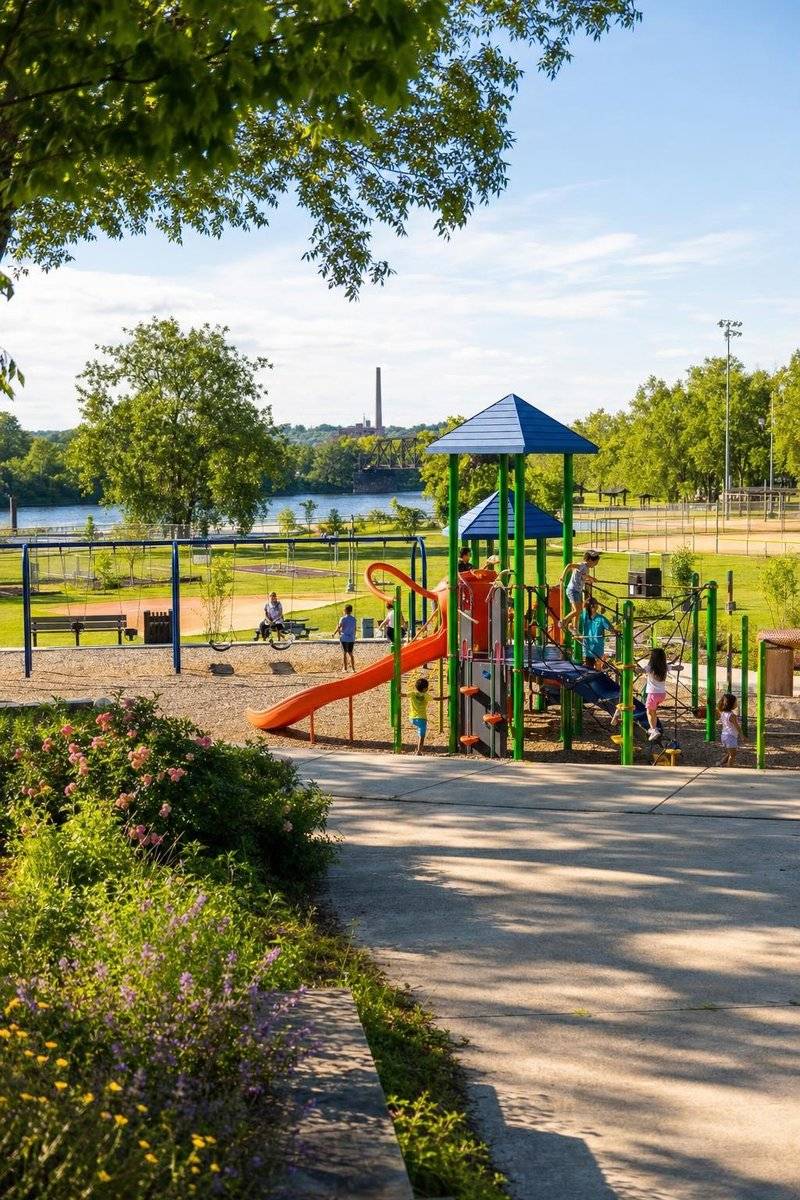
For decades the play equipment at Nash Field in Chicopee, Massachusetts, came down to a set of swings and a single slide. The park had athletic fields and a wading pool too, but for small children there was not much else to do on the bank of the Connecticut River.
A park built for a mill village
Nash Field sits in Willimansett, one of three original villages that grew into the Town, and later the City, of Chicopee. In its busiest years Willimansett was a self-contained place with its own schools, churches, shops and entertainment. Most of its residents worked in the mills that lined the Connecticut River on both the Chicopee and Holyoke sides, and they came from all over the world to do it.
The city dedicated the park in 1925 and named it for a prominent Willimansett family. The point, according to the city's own account, was to bring a bit of nature into a hard-working industrial neighborhood. It hugs the riverbank still. Local reporting has noted that the park is planned as the endpoint of the Connecticut River Walkway, which would tie it into a longer riverside route.
Asking the kids first
A city team working under the name Team Chicopee wrote a proposal called Naturally Nash! and sent it to the Let's Play Construction Grant program run by KaBOOM! with the Dr Pepper Snapple Group. It worked. Chicopee won a $20,000 grant toward new playground equipment for the park. KaBOOM! had also recognized Chicopee as a Playful City, and Nash Field was the first park the city lined up for grant money; a city official noted at the time that it had not been updated in about 30 years.
Before anything was ordered, the team went to the Boys and Girls Club a couple of miles from the field and asked the children there what they would like to see at the park. Students sketched concepts. The final design tried to fit in as many of their ideas as possible, which is a less common step than it should be.
How the $30,000 came together
The grant carried a condition: the city had to spend a total of $30,000 on playground equipment. That left $10,000 to find. City officials committed $5,000 of it and agreed to cover the other project-related costs that fall outside the equipment budget.
The last $5,000 went to residents. Team Chicopee ran an online civic crowdfunding campaign with a posted goal of $5,400, the extra $400 covering card processing and service fees. In short:
- $20,000 from the KaBOOM! and Dr Pepper Snapple grant
- $5,000 from the City of Chicopee, plus related project costs
- $5,000 from residents and supporters online
Fifty-two backers eventually pledged the full $5,400. Progress was not quick. Early in September 2014, Parks and Recreation Superintendent Carolyn Porter told The Reminder that the campaign stood at nearly 20 percent of its goal with 68 days left to go. The pledges caught up before the deadline.
Build weekend
The equipment went in before the money was all in. Work started on August 29, 2014, and a new playscape for younger children was standing by the end of Labor Day weekend, according to The Reminder. About 50 volunteers did the job: players from the Chicopee Comprehensive High School football team, students from the Westover Job Corps Center, and city employees. Local restaurants, bakeries and stores supplied food and materials for the crew. Mayor Richard Kos described the effort as "what makes Chicopee special."
That speed is typical of KaBOOM!-style builds, which rely on a single large volunteer day or weekend rather than months of contractor work. The organization had already supervised a separate build at the Chicopee Boys and Girls Club, where around 150 volunteers finished ahead of schedule.
Why the money mix matters
Nash Field shows how many small city playgrounds actually get paid for. A national grant sets the floor and the conditions. The city fills part of the gap from its own budget. Residents close the rest. Each source on its own would have fallen short, and the grant match is what made a $5,000 local ask worth the effort. For other towns weighing the same route, the site's guide to playground grants lays out how these matching requirements usually work.
The playscape built that Labor Day weekend was described as the first effort at giving Nash Field a new identity. Whether later phases followed, and when the riverside walkway will actually reach the park, are open questions for the next round of city budgets.