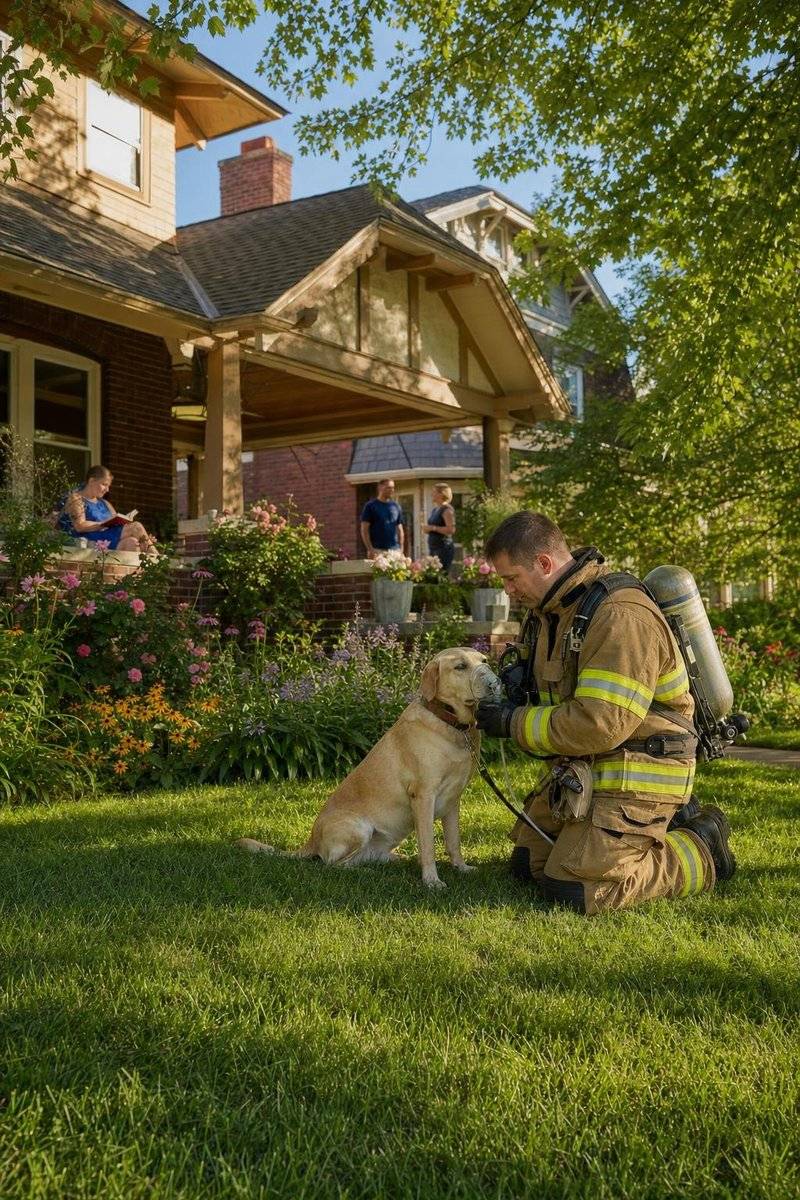
A human oxygen mask does not fit a dog. It is shaped for a flat face and a nose that sits above the mouth, so on a long snout or a cat's small face it leaks, and the oxygen that crews carry for people does little good. Firefighters who pull a pet out of a smoky house have long improvised with whatever they had on the truck.
That gap is what a small group of Omaha pet owners set out to close in 2014.
The problem in numbers
The campaign quoted a national estimate that somewhere between 40,000 and 150,000 pets die in house fires in the United States each year, most of them from smoke inhalation rather than burns. The range is wide because nobody keeps an official national count. Even the low end is large.
Battalion Chief Lloyd Rupp of the Omaha Fire Department put the local side plainly in the campaign description: crews too often see family pets suffering from smoke inhalation and try to give them oxygen with whatever means the crew has at hand. Without a mask made for animals, that usually means holding a human mask close to the animal's face and hoping enough gets through.
What a kit holds
The plan was to put a pet oxygen mask kit on every Omaha fire station. Each kit costs $79 and comes in a brightly colored bag so it is easy to spot in a crowded compartment. Inside are three cone-shaped masks:
- small, for cats and flat-faced dog breeds such as pugs
- medium
- large, for big dogs
The cone shape is the whole point. It slides over the muzzle and seals against the face, so the oxygen from the engine's tank reaches the animal's lungs instead of the open air. The masks connect to the standard oxygen equipment already on the apparatus, which means no new tanks or regulators.
A very small budget
The online civic crowdfunding goal was $1,600. That figure included card processing and service fees, so at $79 per kit the money covered roughly 18 to 20 kits. Seventeen backers pledged the full amount and the campaign was funded.
The kits are cheap. Compared with most municipal purchases this is tiny. A single set of turnout gear for one firefighter costs several times as much. Yet a purchase this size can still slip through the cracks of a city fire budget, because it is not required equipment and does not save human lives directly. Donations are how many American departments have acquired these kits. In 2014 and 2015 alone, news outlets reported kits donated to departments in Illinois by Invisible Fence Brand, and to departments in western Iowa by a local kennel club. Ideas like this one, a single item with a clear price per unit, are among the easiest community fundraising ideas to explain to donors.
What came after
The Omaha Fire Department kept building on the idea. In 2018, KFAB and KMTV reported that the Fetch Foundation, an Arizona nonprofit, and Omaha Animal Medical Group had donated 24 "Fido Bags" to the department, enough to put one on every fire engine in the city.
Later KMTV coverage said the bags were carried on each engine and on battalion chief vehicles for every fire call. The station described a house fire in southwest Omaha where crews used a pet oxygen mask to help revive a dog.
A side note on who carries what
Firefighters train for years on human patients and very little on animals. That is why the arrival of pet masks in a department is often paired with a short session from a local veterinarian, covering how to fit a cone over a muzzle, how to check breathing on a dog and how to keep a frightened cat from bolting. Trade publications for veterinarians, such as dvm360, have covered several of these firehouse training sessions.
For the Omaha campaign, the measure of success was simple. Every kit bought with the $1,600 was meant to ride on a fire apparatus, in a bright bag, waiting for the next call where a family stands on the curb asking about the dog.