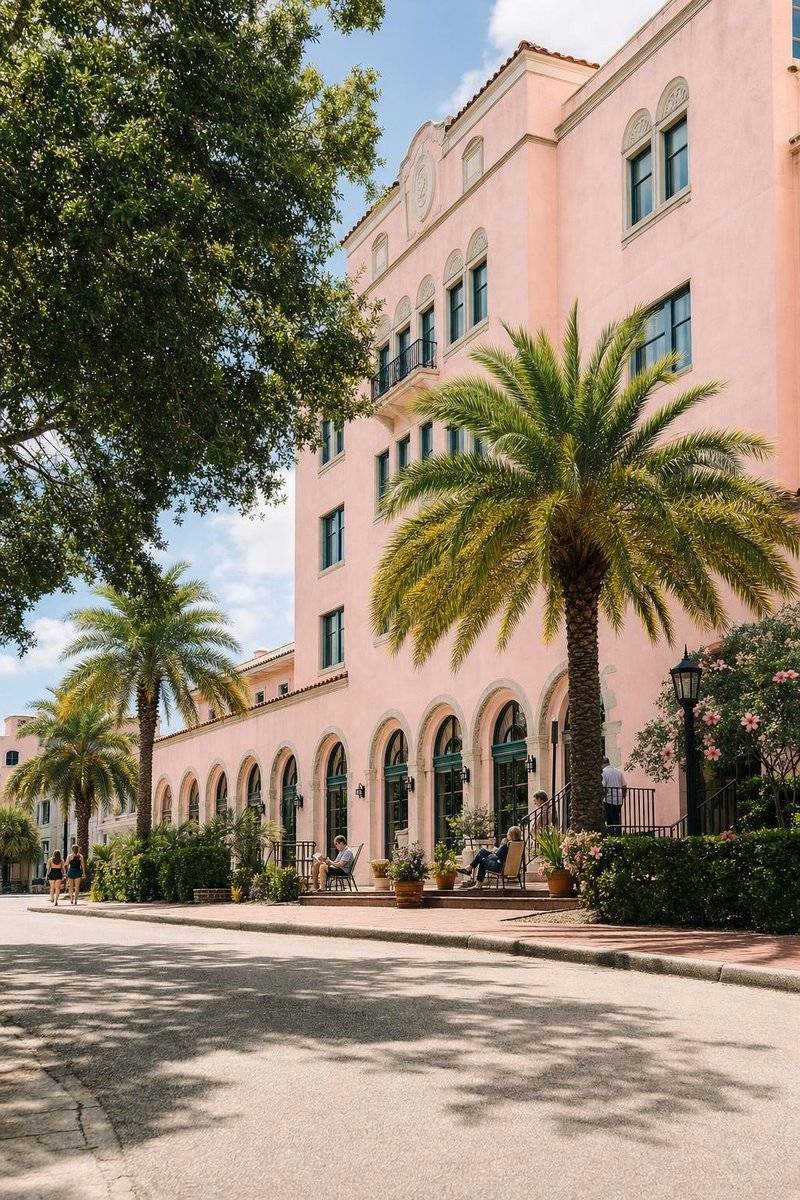
Ed Wynn, the comedian, was master of ceremonies when the Hacienda Hotel opened on Main Street in New Port Richey, Florida, in 1927. Silent film stars came for the occasion. Thomas Meighan and Gloria Swanson were regulars, and the hope in town was that the pink Spanish-style hotel would anchor a "Hollywood of the East" on the Gulf Coast north of Tampa.
For a few years it nearly worked. Several silent films were shot in the area, and actors built houses along the Pithlachascotee River, which winds through town. The boom did not last. By the late 1980s the hotel was empty.
A city that owns a landmark
The Hacienda was added to the National Register of Historic Places on October 24, 1996. A listing protects a building's history on paper, but it does not pay for a roof.
The City of New Port Richey bought the hotel during the real estate boom of the 2000s, expecting a developer to take it on. None did. In the years that followed, the city struggled to find a buyer willing to carry the cost of restoring a building that had sat vacant for decades.
Residents stepped in where buyers would not. More than 400 volunteers turned out for two community clean-up days. Residents, city staff and city council members scraped paint, dug irrigation lines, cleared broken glass and repainted walls and fences around the property.
Paint, though, was the easy part. The harder questions were inside the walls.
What the studies were for
Before anyone could restore the Hacienda, the city needed to know what was wrong with it. A city staff report dated February 5, 2013, had identified the problem areas. The next step was a structural analysis by a licensed professional engineer, carried out with the requirements of the National Register in mind so that any repairs would not cost the building its historic status.
The online civic crowdfunding campaign asked residents, and anyone with a fondness for old Hollywood, to pay for that assessment. The work list was long.
On the structural side it included the east and west walls of the main lobby and the southwest corner of the eastern corridor, all areas where water was getting in, the window and door frames, exit doors, accessibility under the Americans with Disabilities Act, termite inspection and treatment, and checks of the electrical, fire alarm, mechanical, air conditioning and plumbing systems for code compliance. It also covered a search for any underground storage tanks near the western edge of the property.
The environmental side called for an asbestos survey, air quality testing, a mold inspection and a lead-based paint survey.
The goal was $37,800. Forty-four backers pledged $9,252, roughly a quarter of it, and the campaign closed without reaching the goal. Under its all-or-nothing rules, no pledges were collected.
How the restoration was finally paid for
The money came from bigger sources in the end. In 2014 the Florida Legislature approved $1 million toward the restoration. The city then selected a private developer, Florida Motel Inc., to take on the project under an agreement with the city. Renovation ran for several years, alongside a separate makeover of Sims Park, the riverside park next door.
The Hacienda reopened to overnight guests on September 15, 2022, according to local television coverage and the hotel's Wikipedia entry. It now has around 40 rooms, a restaurant and bar, and a courtyard built around the property's original 1920s fountain. The Florida Department of State now features it on the Florida Main Street program's pages about New Port Richey.
A side note on the river
The Pithlachascotee River is usually shortened locally to the Cotee, which is a mercy for visitors trying to pronounce it. It is the river the film people of the 1920s built their houses along, and Sims Park sits on its bank directly beside the hotel.
Projects of this size rarely fit a single funding source. State appropriations, private developers and occasionally municipal bonds carry most of the weight, with smaller public campaigns serving to show that a community cares. In New Port Richey the $9,252 never changed hands, but the 400 volunteers had already made the point.