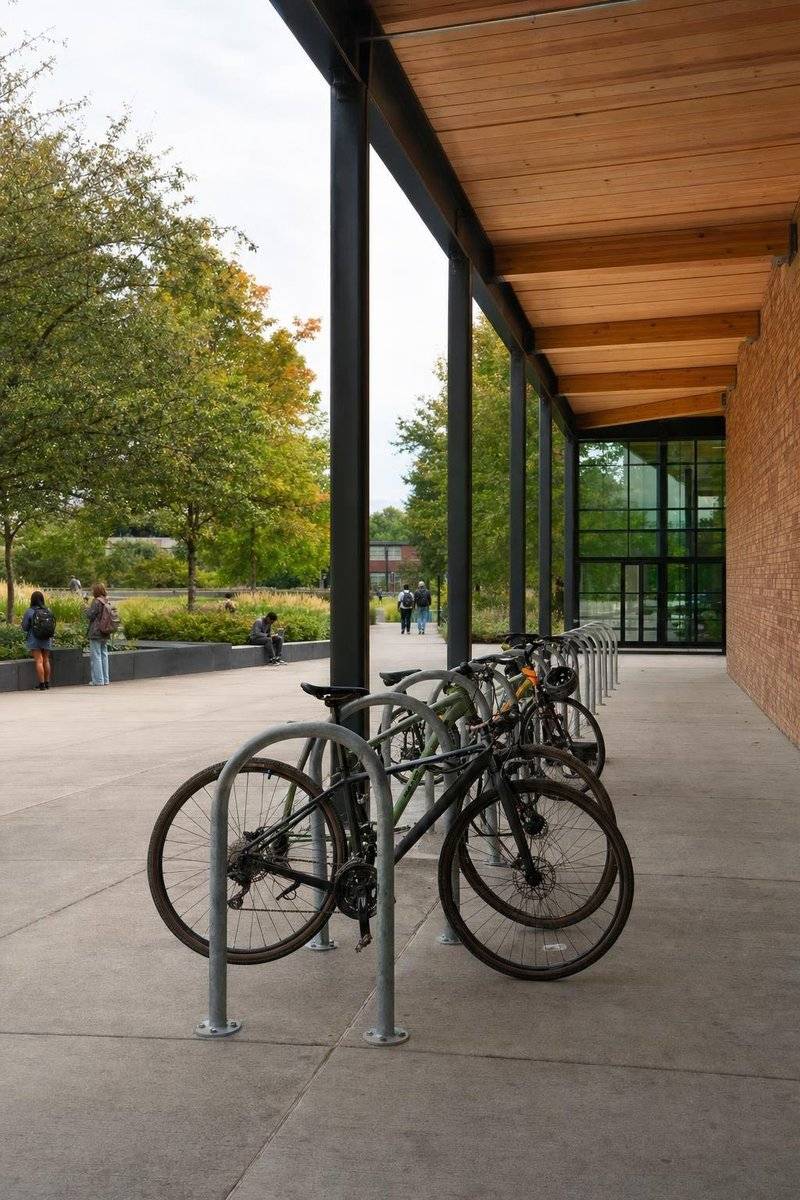
The bike racks at Sheldon High School in Eugene, Oregon, had a nickname among students: wheel-benders. They dated from the 1960s, a long row of slots that held a bicycle by its front wheel and nothing else.
Why the old racks failed
A rack that grips only the front wheel has two problems. The first is theft. A student can lock the wheel to the rack, but a thief only needs to undo the quick release on the hub, leave the wheel behind and walk off with the rest of the bicycle. Sheldon had a run of thefts that worked exactly that way.
The second is damage. When someone bumps a parked bike or trips over the low rack, the bike falls sideways while the front wheel stays clamped. The rim folds. A student walks out of the last class of the day to find a bent wheel, or no bike at all, and no way to get home.
The school did have a handful of solid, modern racks. They filled up quickly, and late arrivals were left with the old row.
The student plan
Sheldon's Green Club, a student-led environmental group, took on the problem. Working with Eugene School District 4J, the club drew up a plan to replace the old racks with inverted-U racks, the simple bent steel hoops that let a rider lock the frame and a wheel together. Each hoop holds two bikes, one on either side.
The full plan called for 70 new racks, room for 140 bicycles, in the covered area in front of the school. Covered parking matters in a city as rainy as Eugene.
Club members also went out on a "change drive," collecting coins and small bills around the community, and made a short video about the racks to explain the project.
Phase 1 in numbers
The club split the work into phases so that each one could be funded on its own. Phase 1 was the first stretch: 17 inverted-U racks along the southern edge of the covered area.
The math was easy to explain to donors. A $60 donation bought one rack, enough for two bicycles. Seventeen racks came to about $1,000. With card processing and service fees added, the online civic crowdfunding goal was $1,080.
Twenty-three backers pledged the full amount, and Phase 1 was funded. A separate Phase 2 campaign followed, aimed at more of the remaining 53 racks.
At $60 a rack, the full set of 70 would have come to roughly $4,200 before fees. That is a small sum for a school district, but it is the kind of expense that rarely rises to the top of a capital budget, which is why a student club raising it piece by piece made sense. The site's guide to proposing a project to the city covers the same approach for residents: break a request into pieces small enough that someone can say yes.
Why the rack shape matters
Bicycle planners have moved away from wheel-holding racks for decades. Guidance from groups such as the Association of Pedestrian and Bicycle Professionals and the Safe Routes to School National Partnership recommends racks that support a bike at two points and let the frame be locked, which is exactly what an inverted-U does. The same Safe Routes guidance suggests that high school clubs and classes can help pay for or even build racks, which is close to what happened at Sheldon.
Eugene has its own local example. A Safe Routes tip sheet describes Roosevelt Middle School, where the city added 20 inverted-U racks after the old wheel-bender racks filled up. Those new racks, holding up to 40 bikes, were full almost every school day.
A side note on the code
Eugene and neighboring Springfield set minimum bike parking at schools in their development codes: one space for every eight students, according to a 2015 regional Safe Routes to School assessment. Sheldon opened in the 1960s, the same decade as its old racks, long before rules like that were written.
No public source found for this page confirms the date the Phase 1 racks were installed or whether all 70 were eventually put in. The plan, at least, was down to the inch: seventeen hoops, southern edge, under the roof.